
Pennsylvania Marriage and Divorce Offices
County custody is the key rule. The Register of Wills, which commonly also serves as Clerk of the Orphans' Court, issues and preserves Pennsylvania marriage licenses. The Prothonotary keeps the divorce file and decree entered by the county Court of Common Pleas. The Pennsylvania Department of Health, Division of Vital Records provides birth and death certificates only. It issues neither Pennsylvania marriage certificates nor divorce certificates and maintains no substitute statewide certificate index for ordering these records.
Quick Reference:
New or copied marriage license: Register of Wills in the issuing county.
Returned marriage certificate: Register of Wills in the issuing county.
Divorce case file and decree: Prothonotary in the county where the decree was granted.
State Vital Records: Birth and death only; no Pennsylvania marriage or divorce certificates.
| Record | Original Issuing / Filing Office | Certified Copy Source |
|---|---|---|
| Marriage application or license | County Register of Wills | Same issuing Register of Wills |
| Returned marriage certificate | County Register of Wills | Same issuing Register of Wills |
| Divorce petition or case file | County Prothonotary | Same county Prothonotary |
| Final divorce decree | Court of Common Pleas | Prothonotary in decree county |
| Birth or death certificate | PA Department of Health | Division of Vital Records |
Pennsylvania Marriage License Rules
Applicants choose a county Register of Wills and follow that office's current application, appointment, appearance, and payment procedure. A license issued by a Pennsylvania county can generally be used anywhere in Pennsylvania, but the issuing office keeps the returned record. Applicants under 18 cannot marry under current law. Both applicants generally provide identity and age information, confidential Social Security numbers where legally required, and facts about any earlier marriage and how it ended.
Pennsylvania ordinarily imposes a three-day wait after application before issuance, subject to a court waiver. The license remains valid for 60 days. State law recognizes authorized judges and religious officials, as well as self-uniting licenses under applicable practice. Questions about online ordination or a proposed ceremony should go to the issuing Register before the ceremony. A ceremony document that is not properly returned may not appear as a completed county record.
The Pennsylvania Historical and Museum Commission marriage-record resource confirms county custody.
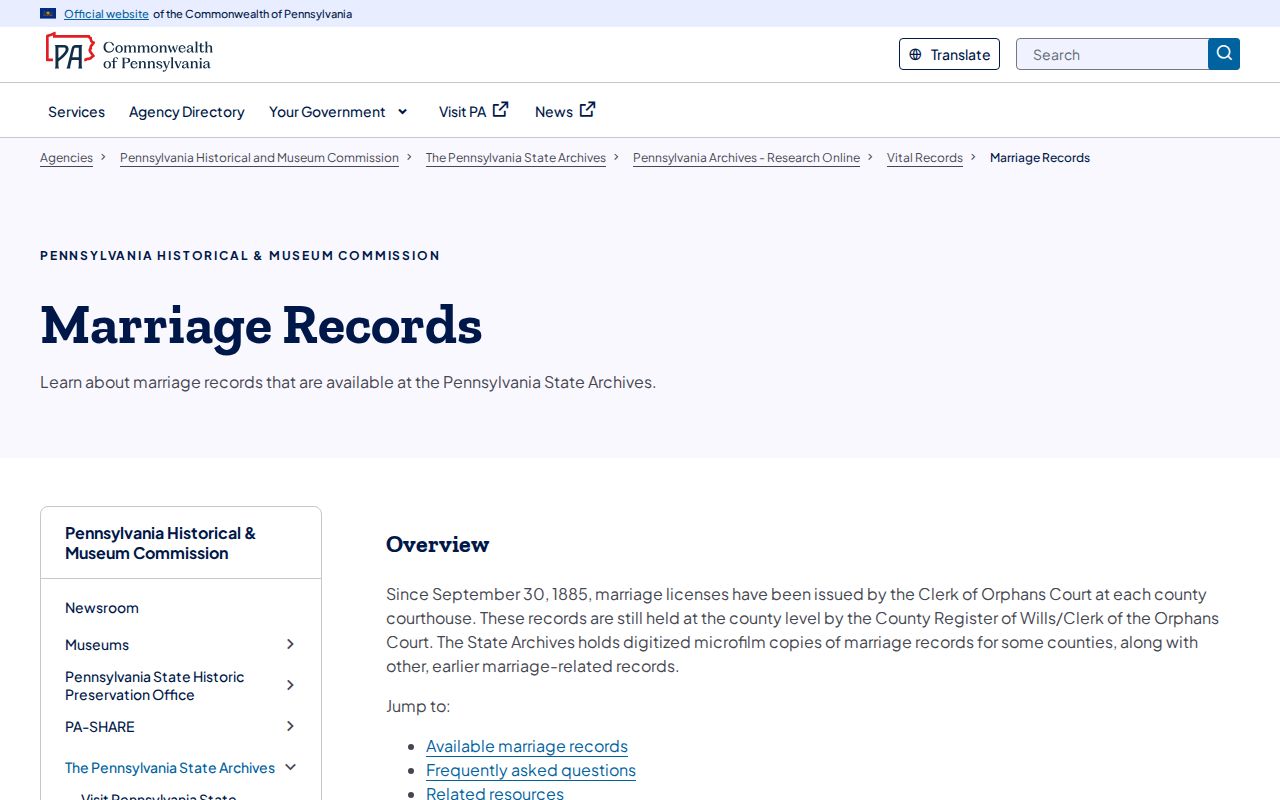
Historical collections can identify an older county record, but certification still depends on the current lawful custodian.
Apply for Pennsylvania Marriage Licenses
There is no single statewide applicant portal with identical fields and options. Some Registers accept an online pre-application followed by an appointment, video oath, or in-person completion. County fees and payment methods differ. Review only the official office instructions for the county selected.
- Select a Register of Wills through the Pennsylvania county directory and read its application and appointment rules.
- Gather government photo identification, age proof, confidential identifying data, and prior-marriage termination details or documents the office requests.
- Complete both applicants' fields and oath through the county's authorized method. Ask for a self-uniting license if that is intended.
- Pay the local fee and observe the ordinary three-day waiting period unless a court grants a waiver.
- Use the license within its 60-day validity and follow an authorized ceremony method.
- Return the completed certificate to the same issuing Register, then order any needed certified copy there.
For foreign use, ask the Register how the copy must be signed and sealed before seeking a Pennsylvania Department of State apostille. Certification and apostille authenticate signatures and seals, not the truth of every statement.
Pennsylvania Marriage Application Fields
The application inventory is a statewide composite, not a promise that every county form looks the same. Social Security numbers and other protected identifiers should not appear in a public marriage image. County wording and local workflow can add fields.
| Field | Required | Notes |
|---|---|---|
| Both full legal names | Yes | Names used before marriage; checked against identification. |
| Address and residence | Yes | Municipality, county, and state. |
| Date and place of birth | Yes | Age and identity proof may be requested. |
| Social Security number | Where legally applicable | Confidential, not a public marriage image. |
| Occupation and parents | Commonly | Parents' names and birthplaces can have index value. |
| Prior marital status | Yes | Never married, divorced, or widowed, with termination facts. |
| Eligibility and relationship | Yes | Applicant certification under Pennsylvania law. |
| Ceremony or officiant type | Conditional | Includes self-uniting practice when selected. |
| Contact and oath | Yes | Used for appointment, delivery, signature, and affirmation. |
Pennsylvania Marriage and Divorce Fees
No uniform total applies across all 67 Pennsylvania counties. Registers set local marriage-license and copy schedules. Prothonotary filing totals combine statewide and county components, while service, publication, copying, certification, archive retrieval, and payment processing can add separate charges. The Department of Health has no marriage or divorce certificate fee because it does not issue either record.
| Item | Amount | Where Paid |
|---|---|---|
| Marriage license | County schedule | Register of Wills |
| Plain or certified marriage copy | County schedule | Issuing Register of Wills |
| Divorce complaint filing | County bundled total | Prothonotary |
| Plain or certified divorce decree | County schedule | Decree-county Prothonotary |
| Marriage or divorce certificate | Not offered | PA Department of Health |
Search Pennsylvania Marriage Records
Marriage licenses from September 30, 1885 forward remain with the issuing county Register of Wills or Clerk of the Orphans' Court. Search using both parties' names at the time of application, approximate application or ceremony date, issuing county, and license number if known. A county may offer an online name index, paid images, mail service, counter inspection, or no remote document access. Ask for a plain or certified copy expressly.
The State Archives and State Library can help with selected historical holdings, but neither replaces every county collection. Search former names, spelling variants, and a date range. When a historical index points to a county volume or license number, return to the present Register for current certification and confirmation.
The State Library vital-record research guide illustrates the historical route.
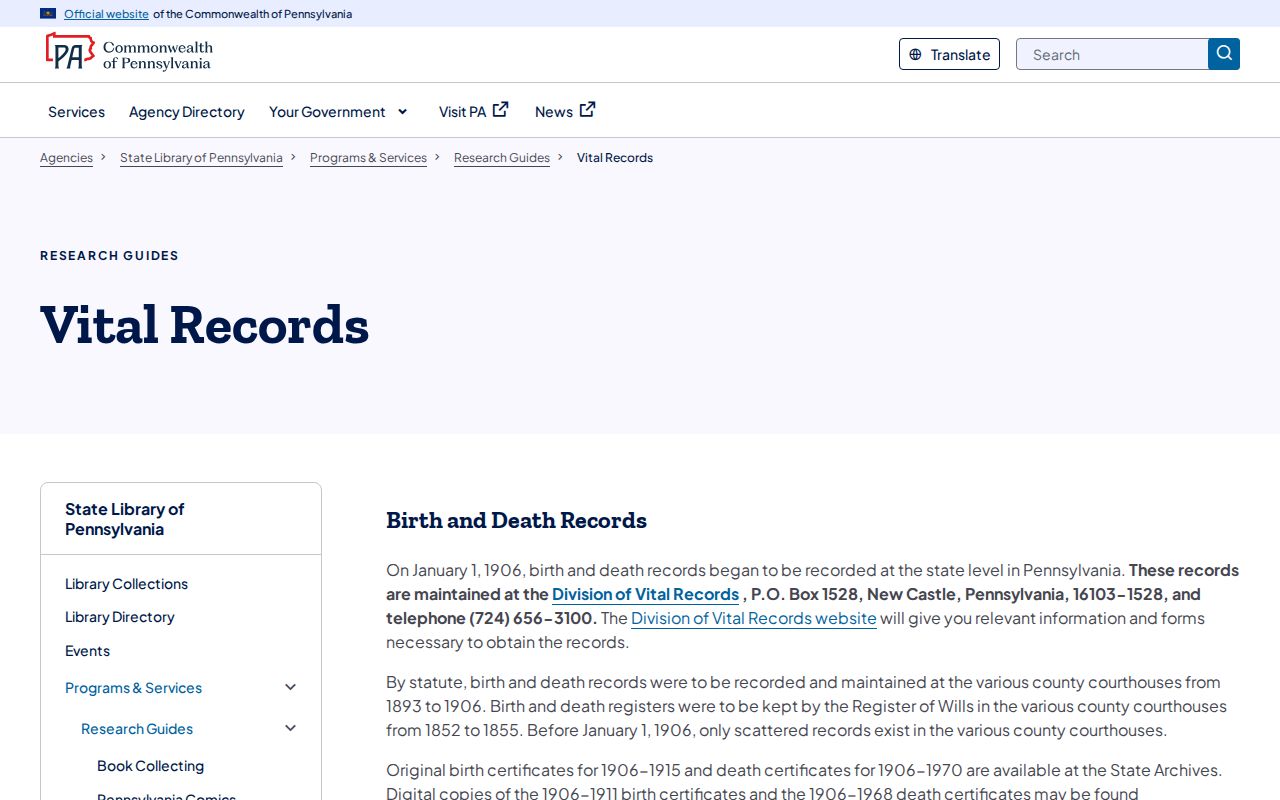
Historical guides help locate a source, while the named county office remains the copy and certification authority.
Find Pennsylvania Divorce Records
The Court of Common Pleas grants divorce, and the county Prothonotary preserves the docket and decree. At least one spouse generally must have lived in Pennsylvania for six months before filing, after which venue rules determine the county. Pennsylvania recognizes consent and separation-based no-fault paths plus statutory fault grounds. Annulment addresses a marriage alleged void or voidable. New common-law marriages could not be created after January 1, 2005, though an earlier claimed relationship may require proof.
Search UJS for available docket metadata, then request the decree or pleadings from the Prothonotary. A divorce file may contain the complaint, service proof, affidavits, consents, motions, property claims, orders, and decree. Financial statements, custody evaluations, protected addresses, minors' information, confidential forms, and sealed exhibits may be withheld or redacted. Custody and support can have distinct dockets and are not automatically resolved by the divorce decree.
Note: A docket caption and decree date may be public even when sensitive family documents remain confidential or redacted.
Certify Pennsylvania Family Records
Certification must come from the county office holding the record. A certified marriage copy comes from the issuing Register of Wills. A certified divorce decree comes from the Prothonotary in the county that granted it. A portal printout can help identify the file, but it is not a sealed certified copy. Ask the recipient whether a plain, certified, exemplified, or apostilled product is required before ordering.
- Identify marriage or divorce, the issuing or decree county, approximate date, and parties' names then used.
- Confirm the office and its current request form, identification rule, copy products, payment methods, and mailing address.
- Give the license or docket number when known and state each document wanted.
- Request a cost estimate for searches, pages, certification, retrieval, postage, or exemplification.
- Review the seal, signature, names, dates, and decree or license number when the copy arrives.
Certification authenticates the county copy. It does not certify that every allegation in a divorce pleading was true or that no later order exists.
Pennsylvania Vital Records Limits
The Pennsylvania Department of Health, Division of Vital Records issues birth and death certificates. It does not issue marriage certificates, divorce certificates, certified marriage abstracts, or certified divorce abstracts. It also is not the custodian of the original county license or Common Pleas divorce case. Requesters should not send marriage or divorce orders, identity papers, or fees there.
This limitation is especially important when an out-of-state agency asks for a "vital record." For a Pennsylvania marriage, explain that the certified county record comes from the issuing Register of Wills. For a divorce, obtain the certified decree from the Prothonotary. Ask the receiving body whether county certification, exemplification, or an apostille is needed.
Do not misroute the request: Pennsylvania Vital Records issues neither marriage nor divorce certificates. Use the issuing Register of Wills or decree-county Prothonotary.
Pennsylvania Department of Health, Division of Vital Records
Certificate scope: birth and death only
Marriage copies: issuing county Register of Wills
Divorce decrees: decree-county Prothonotary
The official program page confirms the agency scope rather than creating a statewide family-record ordering channel.
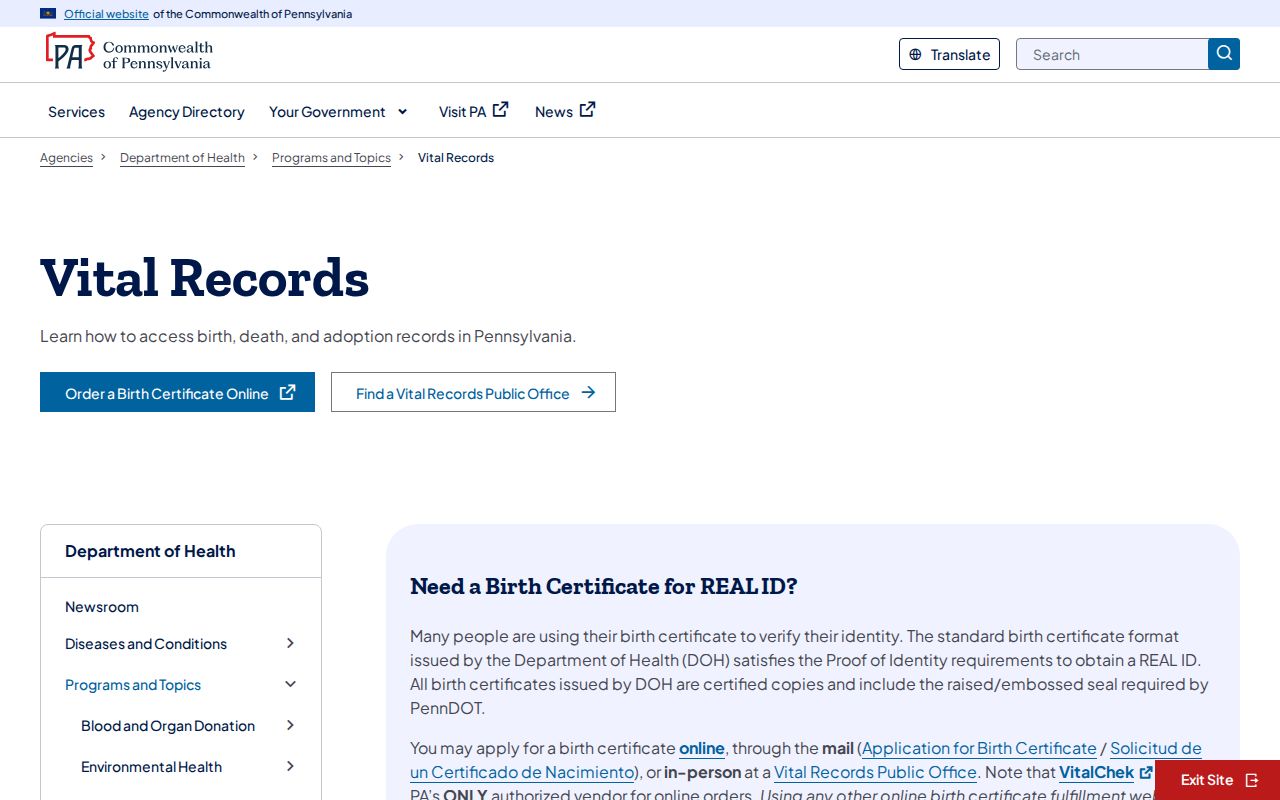
The absence of a state certificate service makes correct county identification the first operational step.
Route Pennsylvania Family Records
Browse the full directory of all 67 Pennsylvania counties to reach the Register of Wills for marriage records or the Prothonotary for divorce records. The relevant marriage county is where the license was issued, which may differ from the ceremony or residence county. The relevant divorce county is where Common Pleas granted the decree, which may differ from a later residence. Shared judicial districts do not merge county Registers or Prothonotaries.
For older Pennsylvania records, ask the county about index books, microfilm, archive transfer, spelling variants, and search service before assuming a missing web result means no record. Give exact names, approximate date, event type, county, and desired copy. County seats identify courthouse communities, but current mailing addresses, office locations, hours, and fees should be verified on the local site before travel or mailing.