
What Pennsylvania Court Dockets Record
A docket is the chronological index for one case. It identifies the court, caption, parties, lawyers, judge, filing date, case category, and status, then lists activity as it occurs. Entries can mark service, a motion, hearing, continuance, order, trial, judgment, sentence, appeal, or remand. Criminal dockets can add count-level charges, OTN, bail, disposition, sentence, and financial information. A docket can name a document without displaying that document. The actual complaint, motion, exhibit, transcript, or certified order may require a separate request.
Pennsylvania's Unified Judicial System links court data statewide, but record custody remains divided. Appellate prothonotaries keep Supreme, Superior, and Commonwealth Court records. County Prothonotaries commonly hold Common Pleas civil and family dockets. Clerks of Courts hold Common Pleas criminal files. The named Magisterial District Court maintains its minor-court record, while Philadelphia Municipal Court uses its own court structure. The statewide index connects these layers without turning AOPC into the custodian of every filing.
The public UJS portal shows how Pennsylvania court dockets are organized by court category.
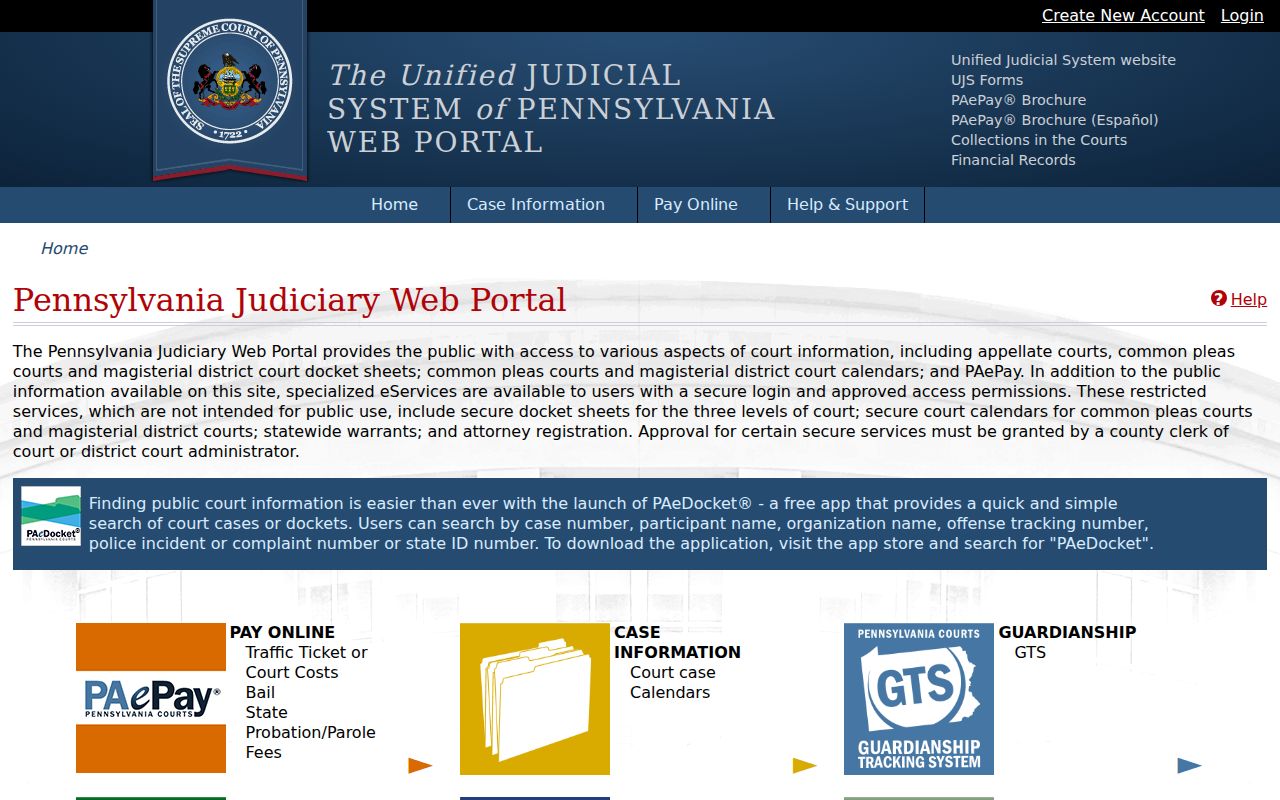
Choosing the correct court category matters because search choices and the depth of the resulting docket differ by level.
Find Pennsylvania Court Dockets Online
The free UJS Case Search provides public docket information for Pennsylvania appellate courts, Courts of Common Pleas, Magisterial District Courts, and Philadelphia Municipal Court categories exposed by the portal. No public account is required. The portal draws from statewide appellate, Common Pleas criminal, and minor-court automation. Coverage depth varies by record series and conversion date. Locally held civil images, probate indexes, exhibits, and restricted matters are not a single statewide document library.
- Identify the level from the paperwork. CP commonly means Common Pleas, MJ identifies a Magisterial District matter, and appellate numbers follow the statewide appellate court conventions.
- Select that court type, then search by exact docket number when known. For criminal or traffic matters, an OTN or citation number can be more precise than a name.
- For participant search, enter surname and given name, then narrow by county. Compare the caption, filing date, case type, and known events before choosing a result.
- Open and print the docket sheet. Read the case header, every event, count or claim outcomes, calendar, sentence, and financial section that applies.
- Use the filing county and court office shown on the docket to order the underlying document or certified copy.
The official UJS Case Search capture represents the statewide search entry used for this Pennsylvania docket workflow.
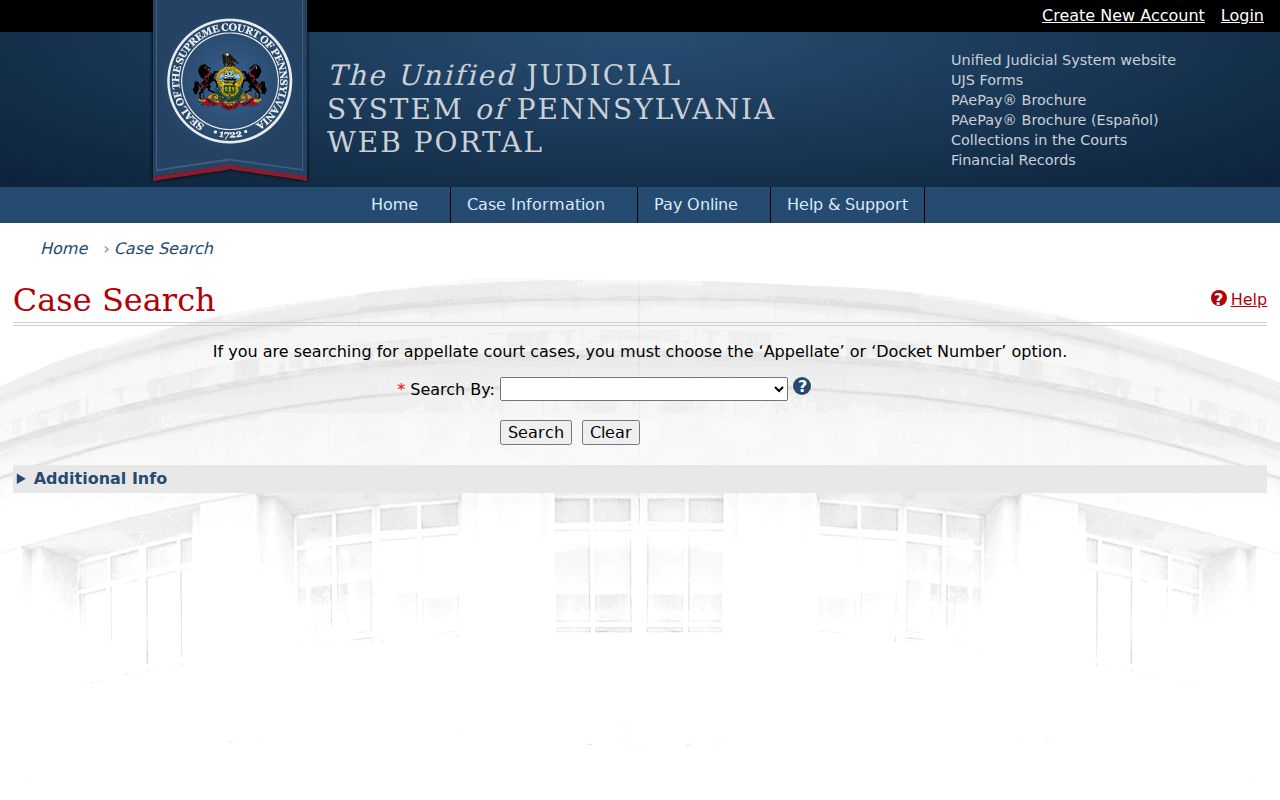
Portal releases can change field order, so the live court tile and official help should control each new search.
Pennsylvania Court Docket Fields
A Pennsylvania docket sheet begins with identifiers and then records activity in sequence. The exact sections differ by court and case type. A criminal sheet can be far more detailed than a civil result fed from a local system. Appellate sheets focus on lower-court references, filings, panels, submission, orders, and opinions. The field inventory below captures the stable concepts, not one permanent screen layout.
| Field | What It Shows |
|---|---|
| Docket and court | The court-specific number, county or judicial district, and court level |
| Caption and participants | The parties, public aliases where entered, lawyers, prosecution, and roles |
| Initiation and status | Filing or initiation data and the current system status, which must be read with later events |
| Charges or claims | Count sequence, statute or cause, grade, offense or claim date, and outcome where applicable |
| Entry date and event | When a filing or court action entered the record and the event or document title |
| Calendar | Event type, scheduled date, judge, location, and cancellation or rescheduling information |
| Disposition and sentence | Count-level result and any confinement, probation, fine, restitution, or conditions displayed |
| Financial section | Assessments, costs, restitution, payments, adjustments, and balance as recorded |
Event date, filing date, and effective date can differ. A later order may vacate, amend, or remand an earlier result. Read through the last entry and obtain the actual latest order when legal rights or a deadline depend on it.
Pennsylvania Courts With Public Dockets
Public UJS search spans Pennsylvania's statewide appellate courts, Common Pleas, Magisterial District Courts, and Philadelphia Municipal Court categories. The content is not identical across them. Pennsylvania has two subject-matter intermediate appellate courts, not geographic appellate districts. Superior Court handles most civil, family, and criminal appeals, while Commonwealth Court handles many government, election, regulatory, and agency matters. Common Pleas is the general-jurisdiction trial court in judicial districts covering all counties.
- Appellate courts: public dockets can show lower-court references, filing history, calendar activity, orders, disposition, and links to released opinions.
- Courts of Common Pleas: statewide criminal docket detail is extensive, while locally managed civil and family documents often require a county system or office request.
- Magisterial District Courts: public categories can include traffic, nontraffic summary, limited civil, landlord-tenant, and preliminary criminal proceedings.
- Philadelphia Municipal Court: portal options reflect its divisions and distinct role in Philadelphia's court structure.
Older Pennsylvania dockets may be held in paper, book, microfilm, or archived form. A missing electronic result should be described as not found in the public online index. Contact the filing office for its historical index and retention route.
Pennsylvania Docket Versus Case File
The docket describes what happened. The full case file contains the papers behind those entries. Pennsylvania's statewide portal offers free public docket sheets, but it is not a universal free PDF repository. A person reviewing evidence, terms of an order, allegations in a complaint, or the exact language of a judgment needs the document from its custodian. The broader Pennsylvania court records process explains that request path.
| Docket | Full Case Record | |
|---|---|---|
| Content | Header, event chronology, status, and selected case data | Pleadings, orders, exhibits, transcripts, and other retained documents |
| Online access | Free through UJS for public categories | Varies by county, court, record series, and restriction |
| Best use | Locate a case, track progress, identify document titles and dates | Read the actual filing or order and support formal legal or historical review |
| Authority | Informational electronic representation | Official copy comes from the court custodian; certification is available when permitted |
| Cost | Public search and print are free | Copying, certification, retrieval, postage, or transcript charges may apply |
Note: Certification authenticates the custodian's copy, but it does not establish that every allegation in the filed document is true.
Read Pennsylvania Court Docket Codes
Pennsylvania docket numbers and labels carry useful context. CP denotes Court of Common Pleas and MJ denotes a Magisterial District matter. Common functional category codes include CR for criminal, CV for civil, TR for traffic, NT for nontraffic summary, LT for landlord-tenant, FC for family, and OC for Orphans' Court. Local civil and estate numbering can vary, so interpret each code within the selected court. OTN means Offense Tracking Number and helps connect complaint, arrest processing, and criminal dockets.
| Docket term | Practical meaning |
|---|---|
| Held for court | Charges passed the preliminary threshold or waiver and moved toward Common Pleas; it is not a finding of guilt |
| Withdrawn | The prosecution withdrew that charge at the recorded stage |
| Dismissed | The court ended the claim or charge at that stage, subject to the order and later history |
| Nolle prossed | The prosecutor formally chose not to proceed on the charge under the applicable procedure |
| Not guilty | An acquittal on that count |
| Guilty or nolo contendere | A conviction when the plea or verdict is accepted and sentence follows |
| ARD | Accelerated Rehabilitative Disposition, a pretrial diversion path rather than a conviction |
| Merged | No separate sentence on that count in the recorded sentencing structure, though the conviction may remain relevant |
A header marked closed or disposed can hide a more complex history. One count may be dismissed while another ends in conviction. A bench warrant may be issued and later lifted. A judgment may be satisfied, stayed, or appealed. Read each event and count, then confirm the latest order with the court if the status affects action today.
Federal Dockets Are Separate
Pennsylvania state and federal cases use different courts, docket numbers, and custodians. A federal civil, criminal, or bankruptcy docket does not appear in the UJS state search. Federal electronic records are accessed through PACER and the relevant federal clerk. Pennsylvania lies within the Third Circuit and has Eastern, Middle, and Western federal districts, along with separate bankruptcy courts.
The assigned PACER image marks that separate federal route.
PACER account and fee terms can change, so its current official information controls. A state and federal matter arising from the same event still requires two searches.
Verify Pennsylvania Docket Events
Public docket data can be incomplete or delayed. A hearing may be continued before the public calendar updates, a filing can enter after the event date, and a later order can change the effect of an older entry. Download a fresh docket and call the named court for an imminent appearance. Technical portal help is appropriate for a search-screen problem. The county or appellate custodian is the right source for missing papers, certification, or the meaning of an office's own entry.
The official UJS Case Search help documents how court and search selections alter the available fields.
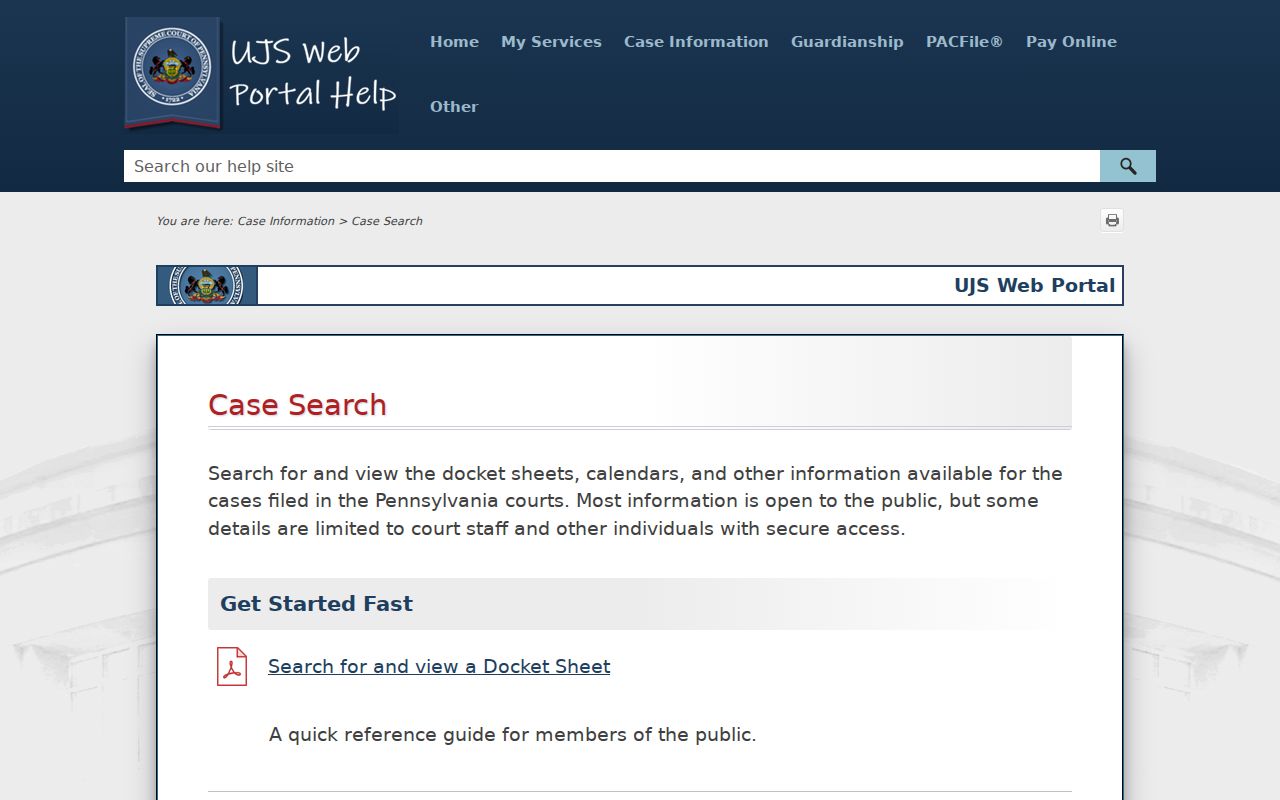
Use that help for current interface behavior, then verify substantive docket content with the office that maintains the official case record.
Find Pennsylvania Court Dockets Locally
The filing county controls the local route. Open the directory of all 67 Pennsylvania counties, then choose the office that matches the docket. Civil and family Common Pleas matters commonly route to the Prothonotary. Criminal Common Pleas matters route to the Clerk of Courts. Estate and Orphans' Court matters use the Register or specialized clerk. Traffic, landlord-tenant, limited civil, and preliminary criminal files remain with the named minor court.
Before an in-person or mail request, confirm the exact office, address, public hours, payment method, security rules, archive location, and whether an appointment is needed. Provide the full docket number, caption, date range, and document titles. When a case moved from minor court to Common Pleas or from Common Pleas to an appellate court, separate custodians may hold the records from each stage.
Tip: Use the statewide docket to identify the filing office, then let the county page supply its verified local request details.