
Pennsylvania Criminal Case Files
A Pennsylvania criminal court record is the judicial file for one prosecution. It is not the same as a police incident report, jail intake sheet, or statewide background check. The filing Magisterial District Court keeps its complaint, preliminary arraignment, bail, and preliminary-hearing material. When charges are held or waived for court, the county Clerk of Courts keeps the Court of Common Pleas criminal file. That later file can include the district attorney's information, motions, orders, plea papers, verdict, sentence, and post-sentence activity. The public docket is a useful index, but a docket line does not expose every filed document.
Pennsylvania criminal matters usually start in minor court. A Magisterial District Judge handles the preliminary criminal steps outside Philadelphia, where Municipal Court fills that role. Common Pleas then handles prosecutions sent forward, including felony and many misdemeanor matters. The caption normally reads "Commonwealth v." followed by the defendant. An OTN, or Offense Tracking Number, connects the arrest and complaint to later criminal dockets. Readers focused only on the accusation can compare Pennsylvania arrest records and court charges, while the case file supplies the later result and sentence.
The Administrative Office of Pennsylvania Courts describes CPCMS and MDJS, the connected systems behind much statewide criminal docket access.
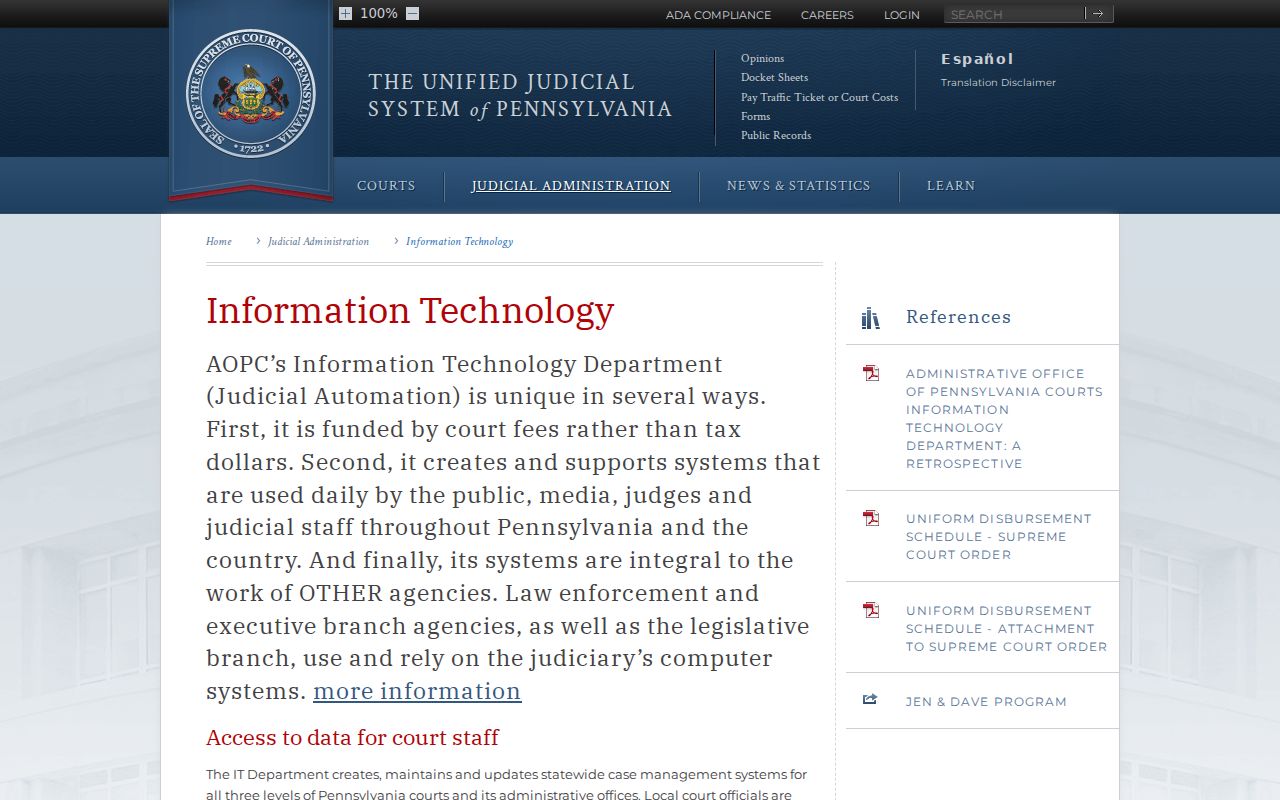
That statewide automation makes public indexing consistent, but each filing court remains the source of its official criminal record.
Search Pennsylvania Criminal Records
UJS Case Search provides free public docket information without an account. Its court choices reach Common Pleas, Magisterial District, Philadelphia Municipal, and appellate cases. Search is query based, not a full downloadable master list. A name may return several people, so match the county, middle initial, case date, charge, attorney, docket, and OTN before drawing a conclusion. Public sheets also warn that portal data may be incomplete or delayed. The court maintains the official record.
- Open UJS Case Search and choose the likely court level. Start with Magisterial District Court for the early complaint, then check Common Pleas for a case held or waived for court.
- Search by docket number when known. Otherwise use the participant name and narrow by county, date, or case type.
- Open all linked dockets. Compare the OTN, complaint number, charge sequence, and originating court so separate cases are not merged.
- Read the full chronology and every count. Later orders, appeals, or resentencing can change a header's simple status.
- Use the Pennsylvania county directory to reach the filing MDJ or Clerk of Courts for public pleadings, certified dispositions, and current fees.
For the actual filing, name the court and county, exact docket number, full caption, approximate date, and each paper wanted. Ask for inspection, a plain copy, a certified copy, or exemplification as needed. A complaint, information, plea colloquy, and sentencing order are distinct documents. Requesting the docket first can reduce needless copy cost. The UJS Request for Access to Case Records supports a precise written request when direct online access stops at docket metadata.
Note: A printable UJS docket is useful research, but only the filing Pennsylvania court can certify the official criminal case document.
Pennsylvania Criminal Case Stages
Police ordinarily submit a criminal complaint to an issuing authority after an arrest or summons. At preliminary arraignment, the Magisterial District Judge states the charges, addresses bail, and sets the preliminary hearing. At that hearing, charges may be dismissed, withdrawn, amended, waived, or held for court. "Held for court" only means the prima facie threshold was met or waived. It is not a finding of guilt. The OTN helps link the MDJ record to the later Common Pleas docket.
Case flow: Complaint Filed › Preliminary Arraignment › Preliminary Hearing › Information and Formal Arraignment › Pretrial Motions › Plea or Trial › Disposition › Sentencing › Appeal
After transfer, the district attorney files a count-by-count information in Common Pleas. Formal arraignment starts plea and motion deadlines. Discovery, suppression motions, competency issues, continuances, and diversion may add entries. Resolution can be a guilty or nolo contendere plea, trial verdict, acquittal, dismissal, withdrawal, or nolle prosequi. Post-sentence motions, Superior Court review, remand, PCRA proceedings, or resentencing may later alter what first looked final. Always obtain the newest docket and latest order.
The official Pennsylvania criminal-history request service shows how a PSP record product differs from this court chronology.
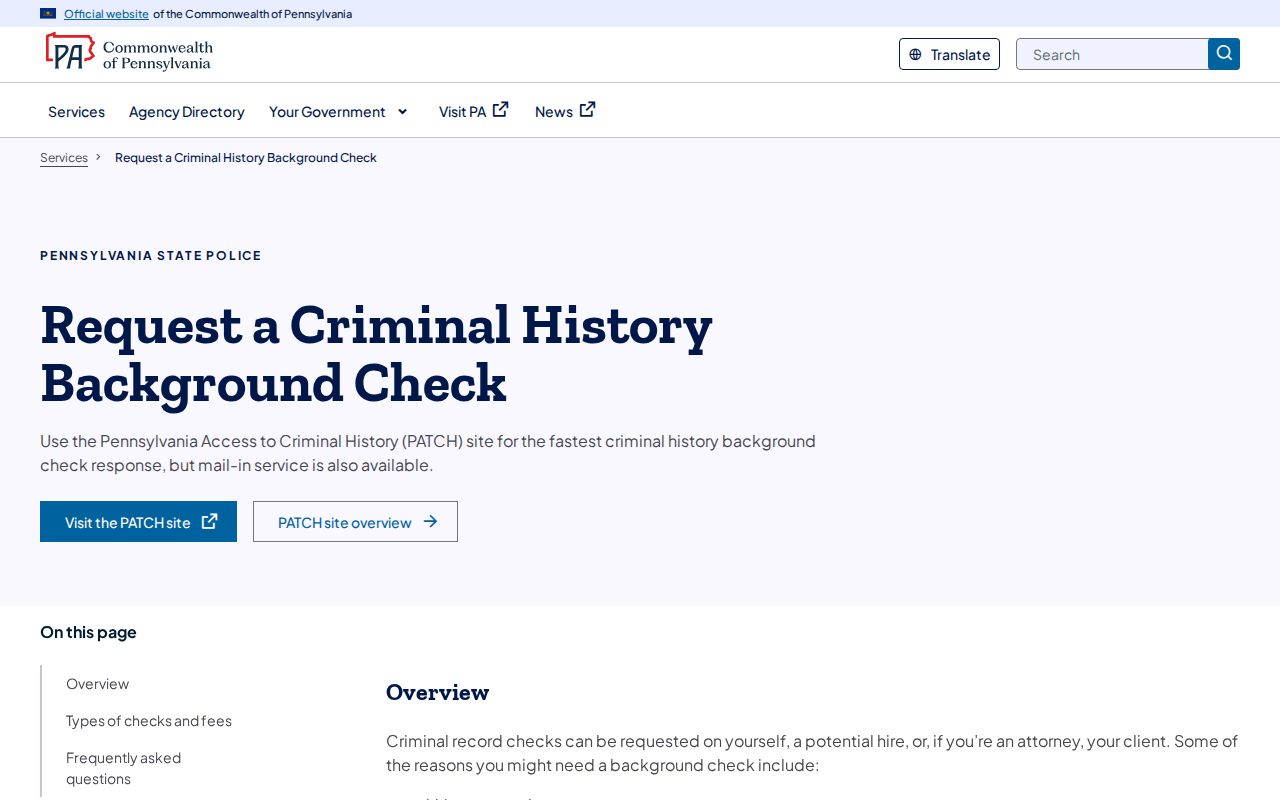
A court chronology answers what happened in one prosecution; PSP compiles reportable Pennsylvania history across agencies and courts.
What Pennsylvania Criminal Records Show
Pennsylvania criminal court records should be read count by count and date by date. One case can contain several allegations with different grades and outcomes. A printable docket can show the index below, while complaints, affidavits, exhibits, transcripts, and signed orders may require a direct court request. Calendar listings can change, so confirm an urgent hearing with the court rather than relying on a saved page.
| Field | What It Shows |
|---|---|
| Docket and OTN | The court's case identifier and the tracking number connecting arrest, complaint, and later court activity. |
| Case header | Court, county, filing date, case status, judge, caption, and originating lower court. |
| Charges | Count sequence, statute and subsection, offense description, grade, offense date, and current count status. |
| Bail and events | Bail type or amount where public, hearings, motions, continuances, orders, trial, and appeal events. |
| Plea and disposition | The defendant's plea and the result for each count, such as guilty, not guilty, dismissed, withdrawn, or nolle prossed. |
| Sentence and money | Confinement range, probation, fines, restitution, costs, conditions, credit, and concurrent or consecutive direction where recorded. |
Money fields need care. Bail is not a fine, restitution repays a victim, and an assessment is not always the current balance. Likewise, a DOC locator does not replace a sentencing order. If a deadline, custody term, or payment turns on the file, verify it with the Clerk of Courts and the actual signed order.
Note: Confirm urgent hearing dates with the Pennsylvania court because a saved calendar entry can be canceled, continued, or rescheduled.
Pennsylvania Charges vs. Convictions
A charge is an allegation. A conviction follows an accepted guilty or nolo contendere plea or a guilty verdict and judgment. Pennsylvania criminal court records can preserve charges later dismissed, withdrawn, reduced, or resolved by acquittal. ARD is pretrial diversion, not a conviction. A count marked merged at sentence may still reflect a conviction even when no separate sentence was imposed. Never turn a booking label, filed count, or "held for court" entry into a claim of guilt.
| Charge | Conviction | |
|---|---|---|
| Meaning | Formal accusation under a cited statute | Guilty result accepted or found by the court |
| Where seen | Complaint, information, and count table | Plea or verdict, disposition, and sentence entries |
| Possible change | May be amended, withdrawn, or dismissed | May be reviewed on appeal or altered by later relief |
Read each count's newest disposition, then scan later appeal and post-sentence entries. A closed header can hide a mixed result, remaining balance, probation issue, or later collateral petition.
Read Pennsylvania Case Outcomes
"Withdrawn" means the prosecution withdrew a charge at that stage. "Dismissed" means the court ended it then. "Nolle prossed" records the prosecutor's formal choice not to proceed. "Not guilty" is an acquittal. Guilty and accepted nolo contendere pleas can support conviction. A waived preliminary hearing does not waive innocence or trial rights as a whole. Pennsylvania grades include first-, second-, and third-degree felonies and misdemeanors, summary offenses, murder categories, and ungraded offenses. Use the statute and count line because the name alone may not reveal the grade.
A sentence should be read for minimum and maximum confinement, probation, fines, restitution, conditions, credit, and whether terms run concurrently or consecutively. Public summaries may not calculate release. Later parole action does not rewrite the conviction. When the meaning remains unclear, a certified sentencing order is more reliable than a top-line docket status.
Pennsylvania Sealed vs. Expunged Records
Pennsylvania's limited-access and Clean Slate remedies restrict qualifying records from ordinary public and most noncriminal-justice disclosure, while authorized agencies may retain access. Expungement is different. It directs removal or destruction of qualifying criminal-history information under statute and court order, subject to limited lawful retention. A missing public result does not prove a case never existed. Juvenile, sealed, limited-access, and expunged records can be absent from both public UJS results and ordinary PSP dissemination.
- Sealed or limited-access record
- A sealing order controls access by its terms. Pennsylvania's main sealing-like remedy blocks ordinary public dissemination, but authorized users can retain access under Sections 9122.1 and 9122.2.
- Expungement
- Qualifying information is removed as the order and law direct. Section 9122 covers defined proceedings, including qualifying nonconviction and other statutory categories.
Start with every docket and a subject-only PSP Access and Review. Separate each remedy, confirm sentence and restitution facts, then use approved statewide forms in the Court of Common Pleas for the prosecution county. The district attorney receives notice as the form and rules require. Eligibility is charge and history specific. The current Pennsylvania Crimes Code Chapter 91 controls.
The official Chapter 91 source also illustrates the legal boundary between Pennsylvania criminal court records that remain public and information restricted by statute.
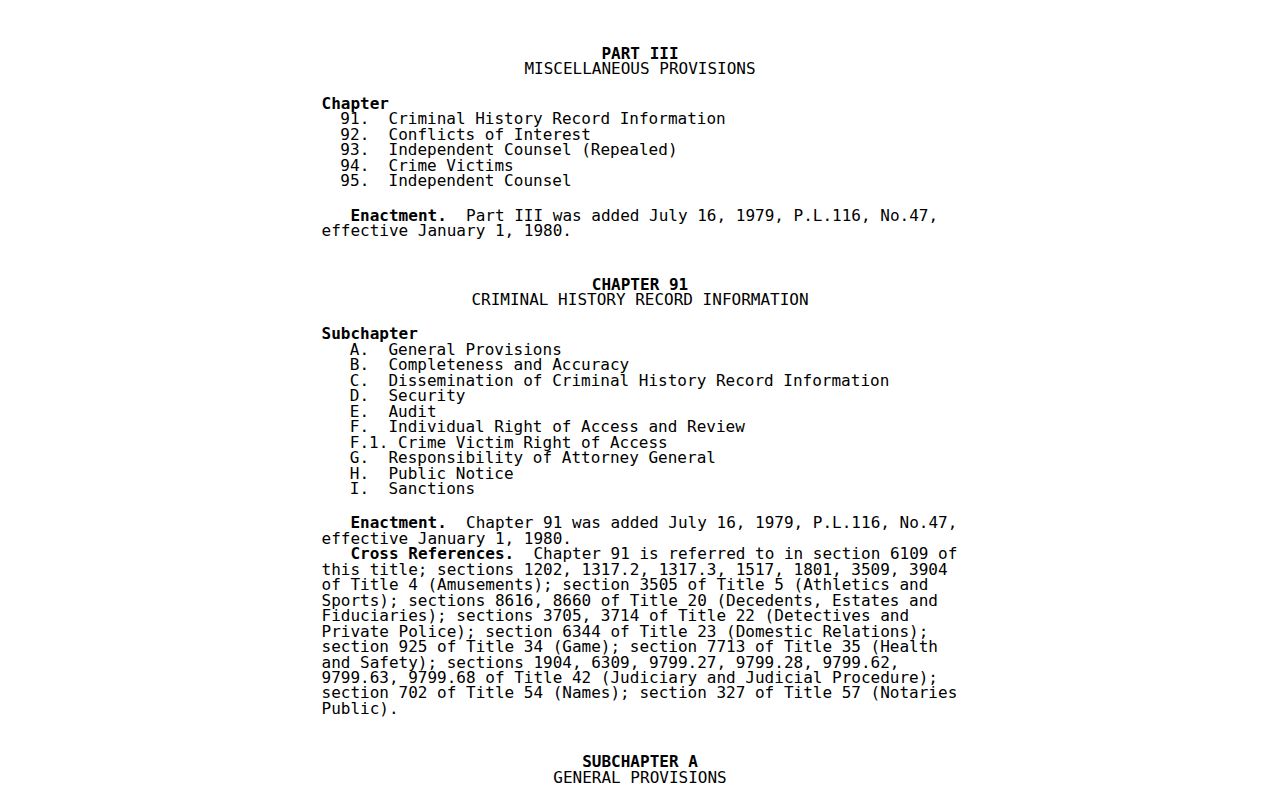
Because relief can vary by count, readers should not infer eligibility from a short portal label or old case summary.
Pennsylvania Criminal Record Access
The UJS Case Records Public Access Policy governs access to court case records, remote limits, confidential information, and redacted versions. Pennsylvania's Right-to-Know Law remains important for agency administrative records, such as releasable jail policies or logs, but it is not the ordinary route to a complaint, information, or sentencing order filed in a judicial case. Those papers go to the court custodian. A police investigative file may remain protected even when the filed complaint is public.
Key Statutes:
18 Pa.C.S. §§ 9121-9122.2 governs criminal-history dissemination, expungement, petition-based limited access, and Clean Slate treatment.
42 Pa.C.S. § 6307 limits inspection of juvenile files to authorized people and statutory exceptions.
Confidential forms and redacted public versions protect Social Security numbers, financial accounts, minors, victim locations, medical information, and other sensitive data. Grand-jury material, sealed affidavits, presentence reports, juror information, and protected exhibits do not become open merely because a public docket line names them.
Pennsylvania PATCH Criminal History
The Pennsylvania State Police Central Repository compiles Pennsylvania law-enforcement arrests, formal charges, and reported dispositions linked to a subject. Pennsylvania Access to Criminal History, or PATCH, offers the standard statewide check. It is not an FBI check, does not cover other states, and does not replace a county docket. Standard noncriminal-justice disclosure is filtered under Section 9121. A subject who needs the fuller Pennsylvania record for accuracy review or relief preparation should use the mail-only SP 4-170 Access and Review process.
| PATCH Field | Use | Requirement |
|---|---|---|
| Request type and purpose | Select standard, volunteer, or the relevant requester flow | Required as shown |
| Requester details | Name or organization, address, and contact information | Required in the applicable flow |
| Subject identity | First and last name, date of birth, sex, and displayed matching fields | Core fields required |
| Aliases and middle name | Helps match former or alternate names | Optional where shown |
| Control number and date | Retrieves an online request's status and certificate | Needed for status check |
A standard check costs $22, with optional notarization adding $5. A qualifying volunteer check is free and cannot be notarized. Subject-only Access and Review costs $20 and is mailed. "Request Under Review" means manual comparison, not presumed guilt. A "No Record" response reflects the identifiers searched and reportable repository data at that time, not proof that the person has never been arrested.
The PSP overview of PATCH results and scope provides the official distinction between a reportable standard response and subject Access and Review.
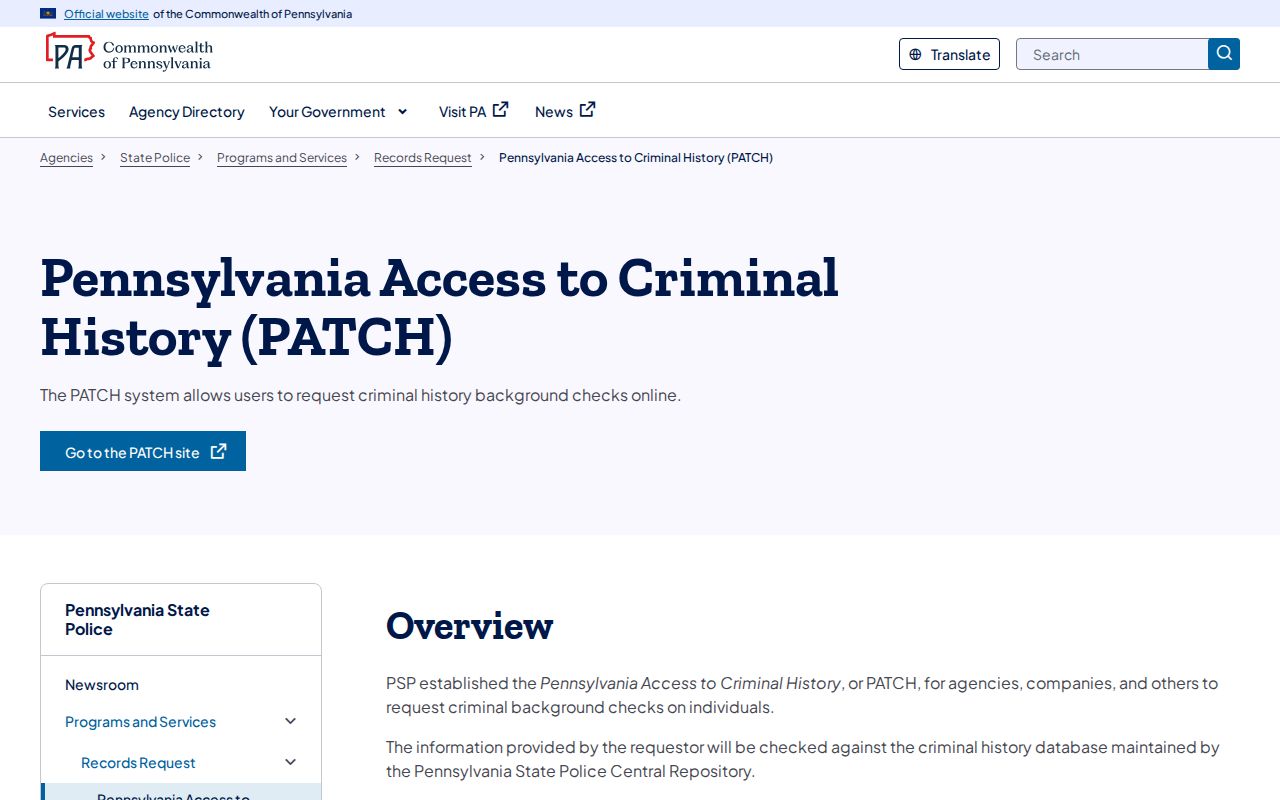
If PATCH and the court disagree, compare the subject report with a certified county disposition, then use PSP's challenge process and ask the Clerk of Courts to correct any bad disposition report.
The official PATCH request portal is the secure place to submit sensitive identifying fields.
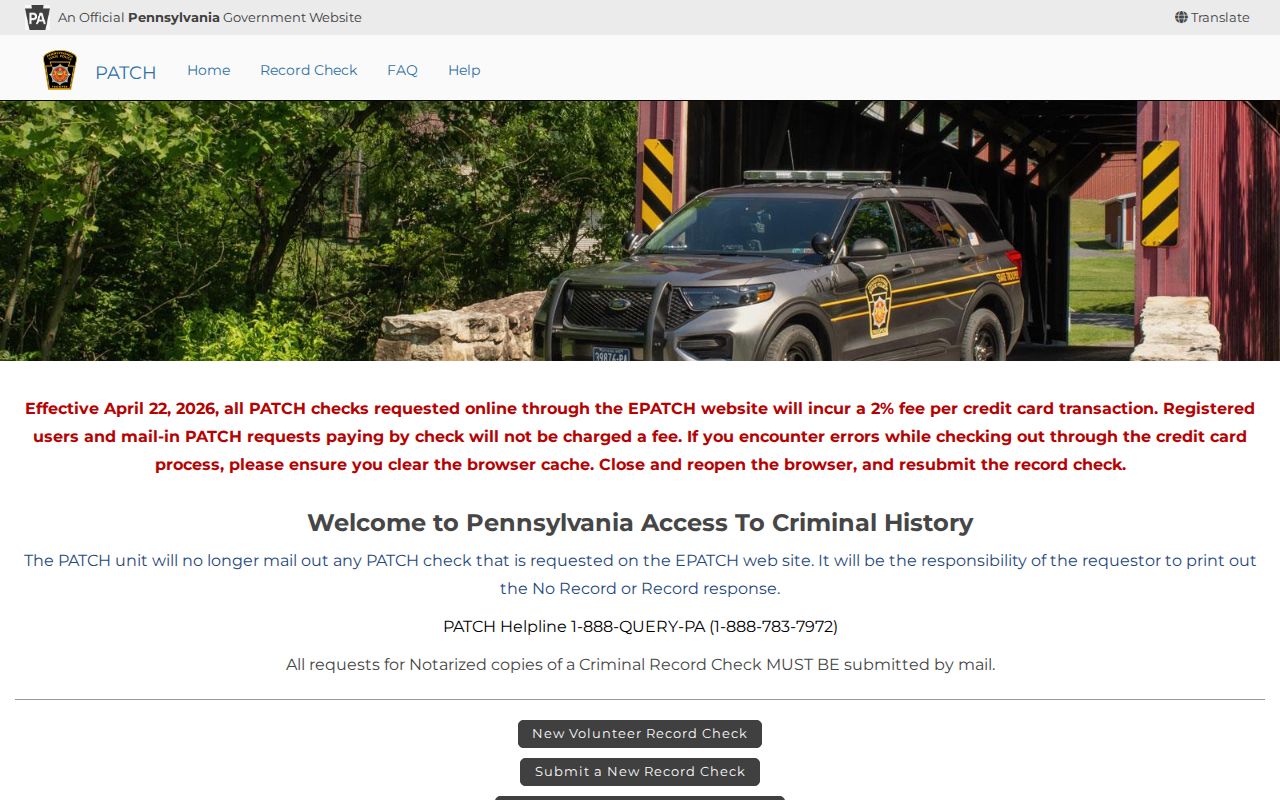
Do not send dates of birth, Social Security numbers, or other repository matching data through ordinary email.
Important: Public docket research is not an FCRA consumer report and must not support employment, credit, housing, or insurance decisions.
Find Pennsylvania County Case Papers
The filing county controls the source papers even when UJS supplies a statewide index. Use the county directory to reach the prosecution county's Clerk of Courts for the Common Pleas file and the named MDJ for preliminary material. One request may not reach both offices. Ask about inspection, digital delivery, archive retrieval, certification, postage, and the current local fee before ordering. Pennsylvania has no single statewide price for plain, certified, or exemplified county criminal copies.
Older files may be on microfilm, in an archive box, or under another custodian. Describe a missing portal result as "not located in the public electronic index," not proof that no case exists. A certified copy authenticates the custodian's document, but it does not prove every allegation in it is true or that no later order exists.
Note: Search online first, then confirm the newest disposition and order directly with the court that holds the Pennsylvania criminal case.