
Search Pennsylvania Court Records
The Unified Judicial System Case Search is Pennsylvania's free statewide discovery tool. Public search features do not require an account. The portal covers docket information exposed for the Supreme, Superior, and Commonwealth Courts, Courts of Common Pleas, Magisterial District Courts, and Philadelphia Municipal Court. Court and search choices change with the selected category. The system can locate an appellate matter, a Common Pleas criminal docket, or a minor-court traffic, nontraffic, civil, or landlord-tenant case. It does not provide every locally held civil image, estate file, exhibit, or transcript.
Start with the exact docket number when possible. An Offense Tracking Number, citation number, or complaint number can also distinguish criminal and summary matters. For a name search, use the legal surname and first name, select a likely county, and compare multiple non-sensitive facts before accepting a match. The public docket is informational and may lag court action. The official file remains with the records custodian.
- Select the court level that appears on the notice, citation, or prior filing. A CP number points to Common Pleas, while an MJ number points to a Magisterial District Court.
- Choose the strongest search key. Use an exact docket, OTN, citation, complaint, or incident number before relying on a common name.
- Filter by county and review the caption, filing date, court office, case type, and status. Do not treat a name alone as proof of identity.
- Open and print the public docket. Read its events, count-level dispositions, calendar entries, and later orders in date order.
- Take the docket number and document title to the correct county or court custodian for inspection, plain copies, certification, or archive retrieval.
The official Pennsylvania Courts public-records gateway shows the statewide access options and policy links.
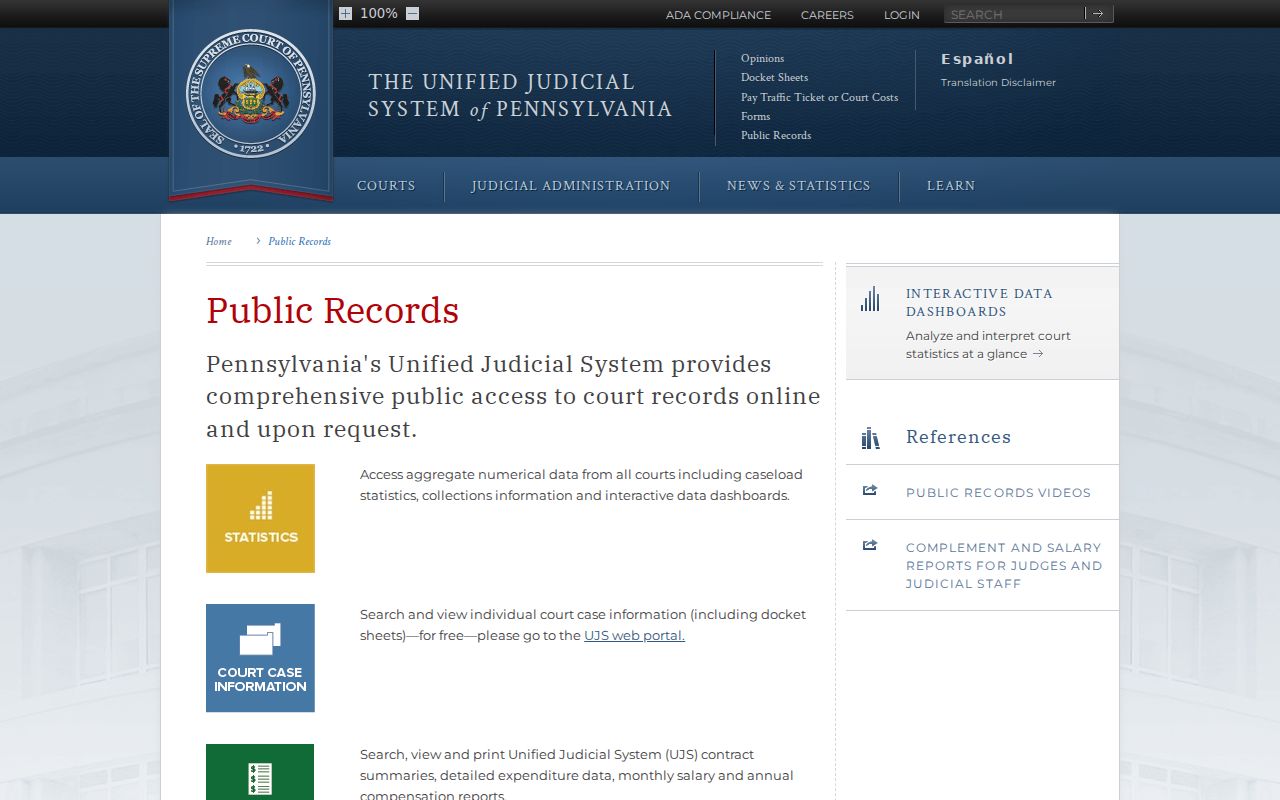
This gateway separates free docket access, formal judicial-record requests, policy material, and aggregate data so each request follows the proper track.
Pennsylvania Court Records Search Fields
UJS search controls are dynamic. The court tile and search method determine which fields appear, so not every field is available in one query. The entries below reflect the principal controls documented by the official portal help. County civil, estate, marriage, and document-image portals may use different fields and coverage dates.
| Field Label | Type | Required | Notes / Format |
|---|---|---|---|
| Court Type | Tiles or dropdown | Yes | Appellate, Common Pleas, Magisterial District, or Philadelphia Municipal categories |
| Search By | Dropdown or tabs | Yes | Participant, docket, citation, OTN, complaint, incident, organization, or scheduled event, depending on court |
| Last and First Name | Text | Conditional | Surname is central to participant search; given and middle names narrow results |
| County | Dropdown | Optional or conditional | Use the filing county to reduce same-name matches |
| Docket Number | Segmented text | Conditional | Copy the Pennsylvania court-specific format and punctuation exactly |
| OTN, Citation, Complaint, or Incident | Text | Conditional | Identifier choices depend on court and case category; include a citation dash |
| Filed or Event Date Range | Date pickers | Optional or conditional | Used in supported docket and scheduled-event searches |
Search results are query based, not a downloadable master index. If an old Pennsylvania court record does not appear, ask the filing office about paper indexes, offsite boxes, archive transfer, or microfilm. Absence from the public electronic index is not proof that no case exists.
Types of Pennsylvania Court Records
Pennsylvania court records follow both the court level and the office function. Common Pleas has general trial jurisdiction, while minor courts handle limited civil claims, landlord-tenant cases, summary matters, traffic citations, and preliminary criminal proceedings. The Prothonotary commonly keeps Common Pleas civil and family material. The Clerk of Courts keeps criminal files. Registers of Wills and Clerks of Orphans' Court preserve estate, guardianship, and marriage records. Local consolidations can change the department name without changing the record function.
- Civil: complaints, answers, motions, orders, judgments, satisfaction, and enforcement papers in Common Pleas, plus eligible minor-court claims.
- Criminal: complaints and preliminary events at minor court, followed by information, pleas, motions, verdict, sentence, and appeal at Common Pleas when held for court.
- Family: divorce, custody, support, protection from abuse, and related orders, with protected material withheld or redacted.
- Probate and Orphans' Court: wills, letters, estate papers, accounts, guardianship, trusts, and other specialized matters, subject to heightened limits for some files.
- Traffic and summary: citations, pleas, hearings, fines, disposition, payment events, and appeals, usually at the named minor court.
- Appellate: lower-court references, briefs, calendars, orders, opinions, and disposition at the statewide appellate courts.
The statewide UJS docket helps identify the route, but the relevant county office supplies the filed pleading or certified order. Juvenile, adoption, mental-health, sealed, expunged, and limited-access cases may be withheld even when the general record class is public.
What Pennsylvania Court Records Show
A public Pennsylvania court record combines identifying data with a chronology. Read the header, each event, and each claim or charge rather than relying only on a top-line status. A closed case can still have a balance, appeal, violation matter, or later order. The docket also distinguishes filing date from hearing or effective date. Public data varies by court and case type.
| Field | What It Shows |
|---|---|
| Docket number | The court, case category, sequence, and year under the applicable Pennsylvania numbering convention |
| Header and caption | Court, county or judicial district, parties, filing date, case type, status, judge, and lower-court reference |
| Parties and counsel | Publicly displayable names, roles, organizations, aliases where entered, and attorneys with the side represented |
| Claims or charges | Civil cause or criminal count, statutory citation, grade, sequence, and count-level outcome |
| Events and calendar | Filings, service, motions, hearings, continuances, orders, trial, sentence, appeal, remand, and future settings |
| Disposition | The result for a count or case, such as judgment, dismissal, conviction, acquittal, withdrawal, or nolle prosequi |
| Financial data | Assessments, costs, fines, restitution, bail, judgment amounts, payments, adjustments, and balance when exposed |
| Documents and limits | Printable docket sheets and some appellate orders or opinions, but not a universal set of every pleading, exhibit, or transcript |
A docket's financial terms are not interchangeable. An assessment is not always the current amount due, bail is not a fine, and a civil judgment is not a court cost. Confirm current balances with the responsible office.
Request Official Pennsylvania Court Records
A complete request identifies the court, county, exact docket number, full caption, approximate date, and every document wanted. Specify inspection, electronic plain copy, paper copy, certified copy, or exemplification. The UJS public-record forms collection provides the case-record access form and separate confidentiality forms used by filers.
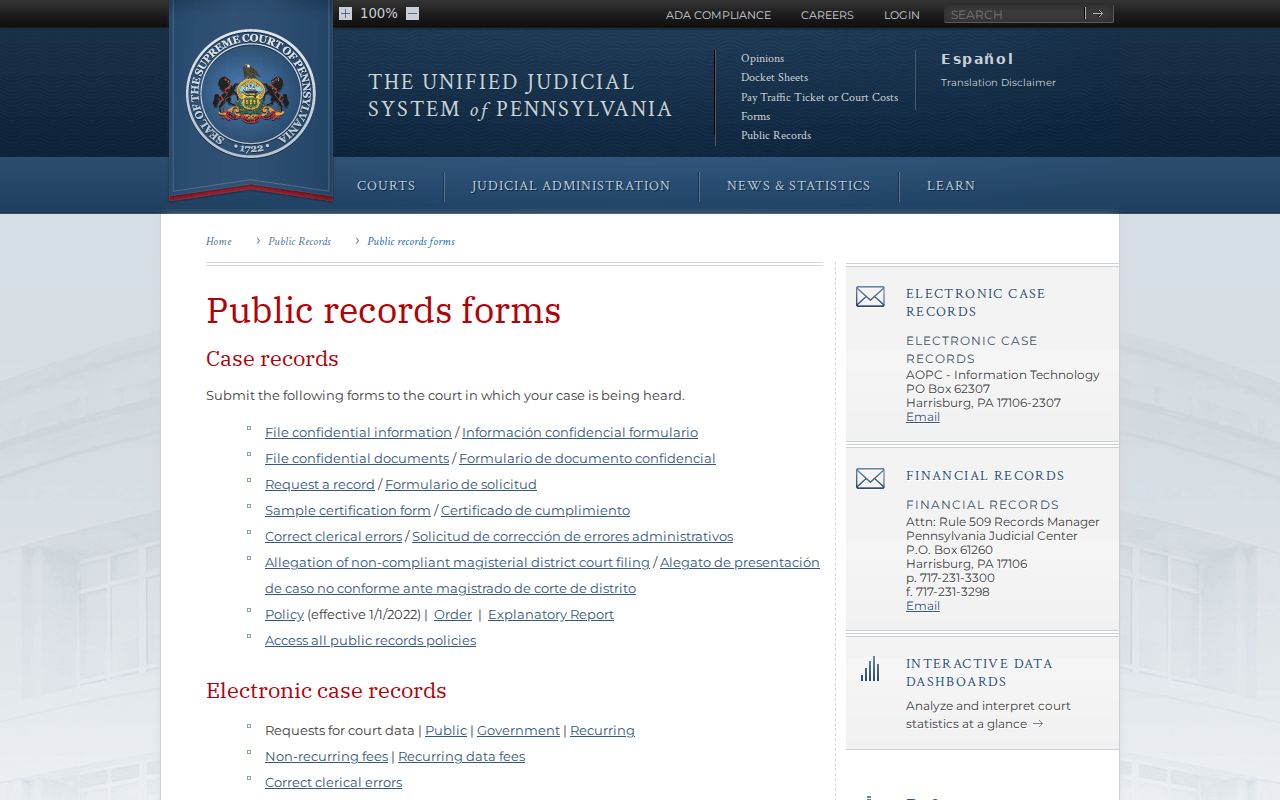
The form asks for requester contact details, case name, docket number when known, a precise record description, delivery or inspection preference, and a signature. Submit it to the custodian that holds the record, not automatically to AOPC.
A request for a civil complaint or divorce decree usually goes to the county Prothonotary. A Common Pleas criminal information or sentencing order goes to the Clerk of Courts. An estate paper goes to the Register of Wills, while a minor-court complaint belongs with the named Magisterial District Court. One case can require more than one office when its early and later stages sit in different systems. Ask for a page count and estimate before ordering a large file.
Pennsylvania Court Records Access Law
Judicial case records follow the Pennsylvania judiciary's public-record policies, court rules, statutes, and the custodian's review process. The Pennsylvania Right-to-Know Law is important for executive and local agency administration, but it is not the usual path to a pleading filed in a court case. A request for a jail policy, agency contract, or qualifying sheriff administrative record can follow the RTKL. A request for a complaint, decree, or sentencing order follows judicial case-record procedure.
The Case Records Public Access Policy governs inspection, copies, remote-access limits, confidential information, and confidential documents. Criminal-history dissemination and Clean Slate limits also arise under Crimes Code Chapter 91. Juvenile-file inspection is separately limited. This division explains why the existence of a public docket line does not make every item named on that line open for remote viewing.
The official policy library illustrates how Pennsylvania court records access rests on court-specific rules rather than one broad agency-record request.
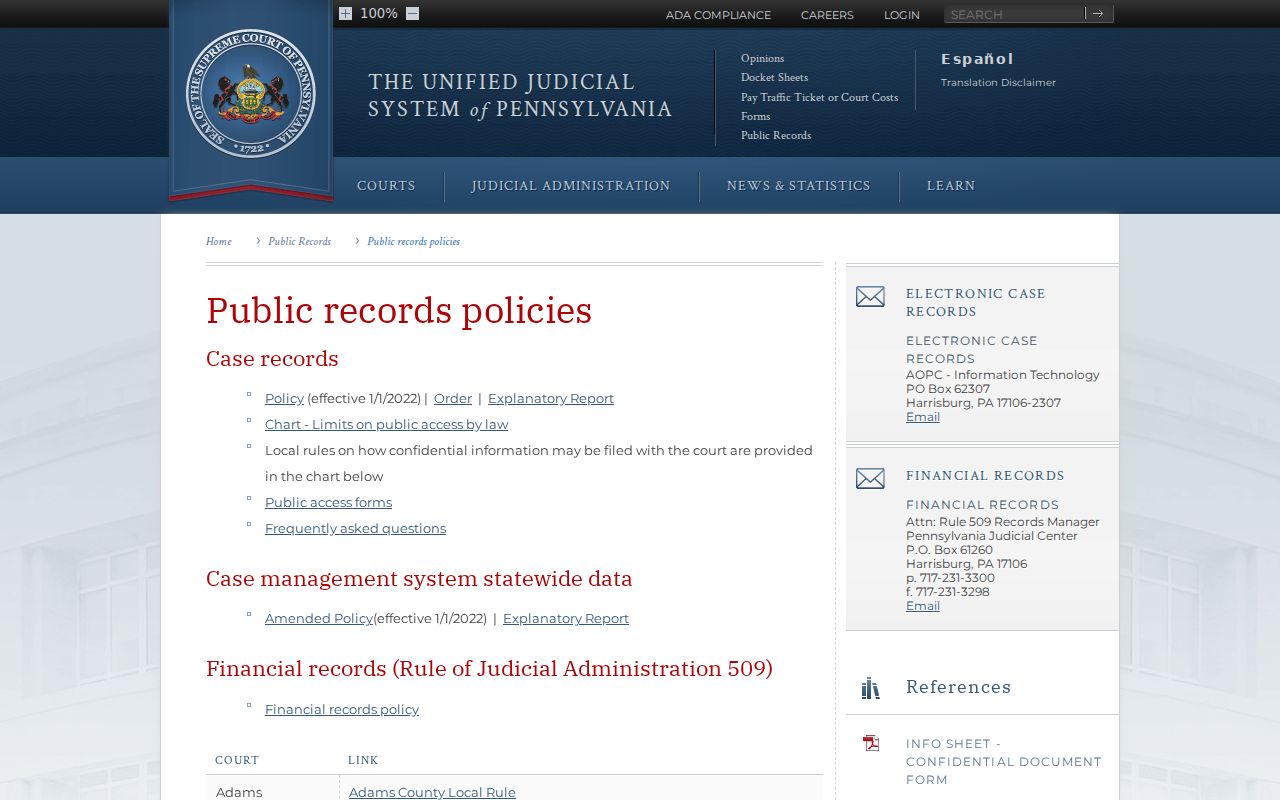
Use the policy named by the custodian when challenging a denial or redaction. An Office of Open Records appeal does not replace review of a judicial case-record decision.
Note: Public docket access does not grant access to confidential forms, sealed exhibits, protected identifiers, or restricted case classes.
Restricted Pennsylvania Court Records
Pennsylvania restricts juvenile and dependency files, adoption records, mental-health material, sealed documents, expunged information, and records covered by limited access or Clean Slate. Public filings also omit or redact Social Security numbers, financial accounts, minors' identifiers, protected addresses, medical information, and victim-sensitive data. A public version can exist while its paired confidential form remains secure. A missing public result may therefore reflect lawful restriction instead of a database error.
Expungement and limited access are different remedies. Expungement removes qualifying information as the statute and order direct. Limited access blocks ordinary public dissemination but preserves authorized criminal-justice access. A petitioner identifies each docket, charge, disposition, sentence completion, and later record, then files the approved materials in the Common Pleas court for the case county. Eligibility depends on current law and the full history, so a brief docket view cannot promise relief.
Pennsylvania Courts publishes statewide forms and court-specific collections for record access and qualifying proceedings.
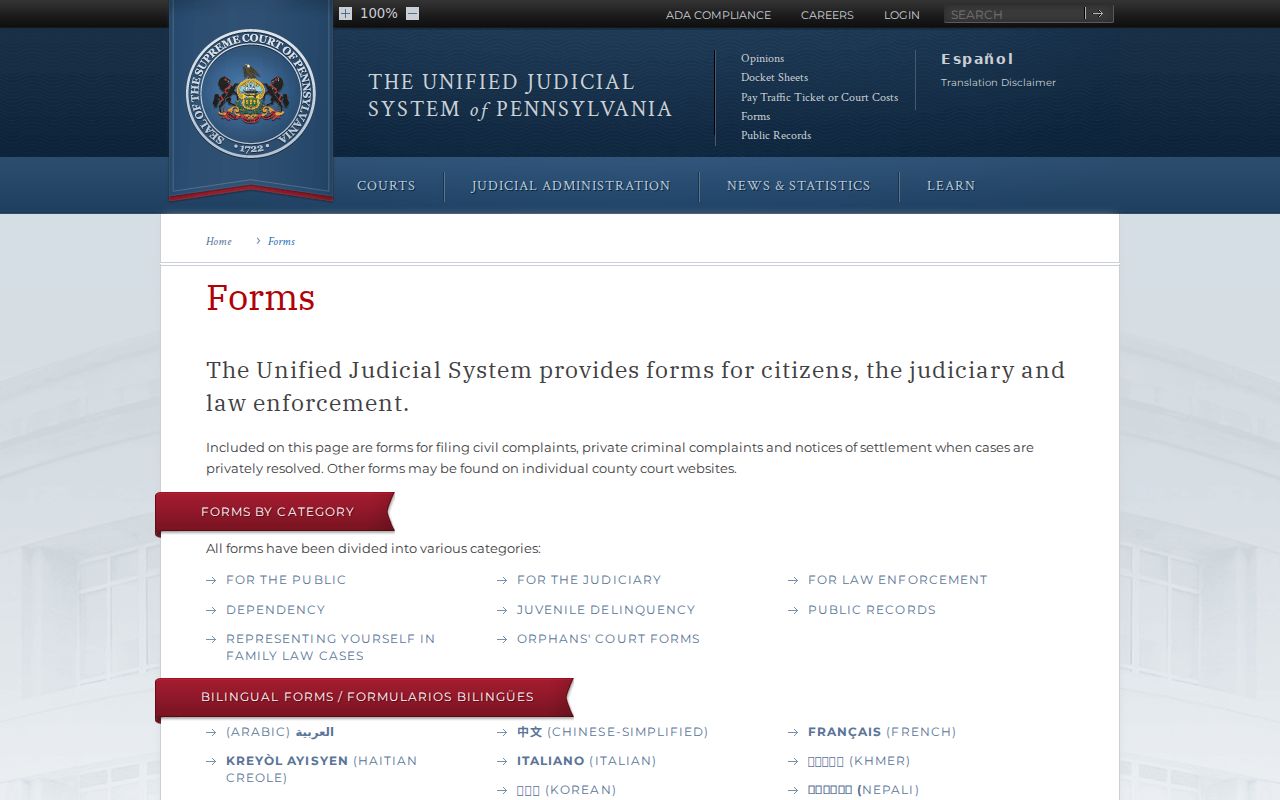
Always use the current form revision and confirm local filing instructions with the Clerk of Courts before submitting a petition.
Pennsylvania Court Record Costs
UJS public docket search and printing are free. Pennsylvania has no single retail copy price that controls every county row office and every record product. A plain page, certified copy, exemplified copy, archive search, transcript, postage, or specialized medium can carry different charges. County filing and copy schedules may combine state-authorized components with local surcharges. Ask the custodian for the page count, certification type, search or retrieval charge, postage, and full estimate before paying.
A free docket print is useful for locating and narrowing a file, but it is not a certified copy. Certification authenticates the copy as issued by the custodian. It does not prove that allegations in the record are true or that no later order exists. Transcript preparation may follow a separate court-reporter process and deposit rather than ordinary per-page clerk copying.
Note: Inspection or electronic delivery may reduce cost, but any waiver depends on the governing court or county policy.
Find Pennsylvania Court Records Offices
Pennsylvania's 67 counties do not share one generic county clerk. Route civil and divorce records to the Prothonotary, criminal Common Pleas records to the Clerk of Courts, estate records to the Register of Wills, and Orphans' Court or marriage-license records to the specialized county office. Traffic, summary, landlord-tenant, and preliminary criminal records remain with the named minor court. The Pennsylvania county directory leads to the local site for the filing county, while the Pennsylvania clerk structure explains which row office performs each function.
Confirm the current address, public hours, security rules, payment method, appointment needs, and archive location before traveling. Bring the docket or estate number, full names, year variants, and document titles. If a case moved or was appealed, read the docket for the receiving court and request each document from the office that actually holds it.
Tip: Select the filing county first, then match the case type to the Prothonotary, Clerk of Courts, Register, or minor court.