
Search Pennsylvania Court Records
The free UJS Case Search is Pennsylvania's statewide discovery tool. It exposes public docket information from the Supreme, Superior, and Commonwealth Courts, Courts of Common Pleas, Magisterial District Courts, and available Philadelphia Municipal Court categories. No public account is required. The portal can identify a docket and court, but it is not a warehouse for every complaint, exhibit, transcript, or certified order. Protected cases and data are excluded by law and judicial policy.
Search by exact docket number when known. For criminal matters, an Offense Tracking Number can be a strong key. Traffic searches work best with the full citation number and dash. A name search should include county and other non-sensitive facts because a same-name match does not establish identity.
- Identify the court level from the notice, citation, or docket prefix, then choose its portal tile.
- Enter the exact docket, OTN, citation, organization, or participant name supported for that court.
- Filter by county and compare the caption, filing date, case type, and known events before selecting a result.
- Open the docket sheet and read the header, events, charges or claims, disposition, sentence, and financial entries.
- Take the docket number to the correct county office for filed documents, certification, or older material.
| Search Control | When to Use It | Important Detail |
|---|---|---|
| Court Type | Every search | Fields change for appellate, Common Pleas, MDJ, and Municipal categories. |
| Participant Name | When no identifier is known | Add county and spelling variants; verify identity independently. |
| Docket Number | Best exact case key | Copy the Pennsylvania court-specific format precisely. |
| OTN | Criminal records | Connects an offense-tracking record to court processing. |
| Citation Number | Traffic records | Include the dash, such as A5368532-1. |
| Scheduled Events | Calendar lookup | Confirm urgent dates directly with the court. |
Pennsylvania Court Records Hierarchy
The Pennsylvania court system forms a pyramid. The seven-justice Supreme Court is the final state appellate authority and administers the Unified Judicial System. Superior Court hears most criminal, civil, family, and children's appeals. Commonwealth Court handles government, agency, election, and public-law matters. These are two statewide subject-matter appellate courts, not geographic appellate districts.
Courts of Common Pleas provide general trial jurisdiction in 60 judicial districts that cover all 67 counties. Seven districts pair two smaller counties, but each county keeps its own records offices. Magisterial District Judges handle summary offenses, traffic, preliminary criminal matters, landlord-tenant cases, and civil claims within their limit. Philadelphia Municipal Court performs comparable local functions. Filing court and subject matter determine the custodian and appeal path.
Typical path: Magisterial District Court or Municipal Court › Court of Common Pleas › Superior Court or Commonwealth Court › Supreme Court of Pennsylvania
| Court | Jurisdiction | Case Types |
|---|---|---|
| Supreme Court | Last-resort and specified direct review | Allowance petitions, direct appeals, rules, discipline |
| Superior Court | Most Common Pleas appeals | Criminal, civil, domestic-relations, family appeals |
| Commonwealth Court | Government and agency matters | Administrative, election, zoning, public-law cases |
| Court of Common Pleas | General trial jurisdiction | Felony, major civil, divorce, juvenile, estate, appeals |
| Minor and Municipal Courts | Limited local jurisdiction | Traffic, summary, landlord-tenant, small civil, preliminary criminal |
The official Unified Judicial System home page presents the statewide court network.
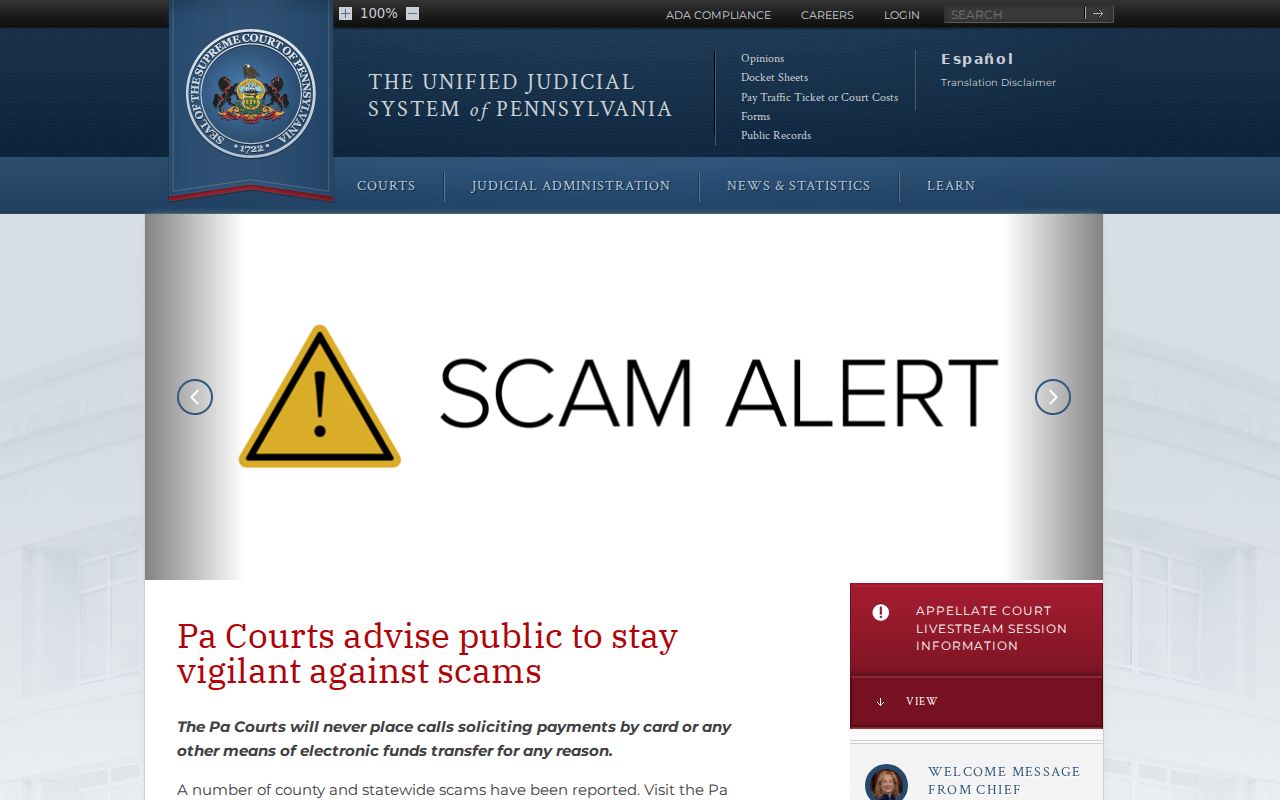
The hierarchy is unified for administration, while original records remain with the filing court and county offices.
Pennsylvania Court Record Types
Record type determines both court and office. Pennsylvania does not use one generic county clerk for every file. Prothonotaries commonly keep Common Pleas civil and family filings. Clerks of Courts keep Common Pleas criminal files. Registers of Wills handle estate administration and marriage licenses, while Clerks of the Orphans' Court preserve that division's petitions and orders. An MDJ or Municipal Court keeps its own limited-jurisdiction file.
- Criminal records include complaints, informations, pleas, motions, verdicts, sentence orders, and costs.
- Civil records include complaints, answers, motions, judgments, liens, foreclosure, and name-change matters.
- Family records include divorce, custody, support, and protection matters, subject to added privacy limits.
- Probate and Orphans' Court records include wills, estates, guardianships, trusts, and related orders.
- Traffic and summary records begin in minor courts and can move to Common Pleas on appeal.
- Juvenile and dependency records have strict statutory access limits despite their place in the court system.
Read Pennsylvania Court Records
A public docket is a chronology, not merely a top-line status. It identifies the court and case, then records participants, counsel, claims or charges, scheduled events, filings, orders, disposition, sentence or judgment, and financial entries where applicable. A case marked closed can still show an appeal, unpaid balance, probation issue, later petition, or modified order. Event date, filing date, and order date can differ.
- Docket number
- The court-specific identifier used to retrieve the file and request documents.
- Caption
- The formal case name, such as Commonwealth v. a defendant or one civil party against another.
- Disposition
- The outcome of a charge or claim, which must be read count by count.
- Held for court
- A preliminary threshold moved charges to Common Pleas; it is not a finding of guilt.
- Nolle prossed
- The prosecution did not proceed with that count under applicable procedure.
A docket line naming a sealed exhibit, presentence report, or protected form does not make its contents public. Obtain the latest actual order when rights or deadlines depend on the record.
Pennsylvania Statewide Record Systems
Several Pennsylvania systems answer different questions. UJS Case Search locates public court dockets. PATCH, run by the Pennsylvania State Police Central Repository, supplies reportable Pennsylvania criminal-history results rather than a full county case file. The Department of Corrections Inmate/Parolee Locator covers state-sentenced people and DOC-supervised parolees, not county jail custody. PA SAVIN/VINELink supports custody and court notifications based on participating feeds.
PATCH
State criminal-history repository result, distinct from certified county dispositions.
DOC Locator
State prison and parole supervision data, excluding county jail rosters.
PennDOT Driver History
License status, reported convictions, points, and administrative actions.
Megan's Law Registry
Public registered-offender information under the registry's legal limits.
PA Vital Records
Birth and death certificates only, not marriage or divorce certificates.
PennDOT driver histories are authorized personal-record products, not open name searches. Pennsylvania marriage records stay with the issuing county Register of Wills, and divorce decrees stay with the county Prothonotary. A county jail roster, DOC profile, PATCH response, court docket, and sex-offender profile can concern one person yet remain separate records with separate custodians.
Pennsylvania Court Records Access Law
Judicial case records follow the Supreme Court's Case Records Public Access Policy, related law, and court procedures. Pennsylvania's Right-to-Know Law remains vital for state and local agency records, but it is not the usual route for a complaint, divorce decree, sentence order, or estate filing. Those requests go to the judicial custodian. Administrative jail policies, contracts, and other agency materials may use the agency Open Records Officer and RTKL process instead.
Key Pennsylvania authorities:
Right-to-Know Law, 65 P.S. §§67.101 et seq. presumes many agency records public but treats judicial access through its judicial-agency provisions.
UJS public-record policies govern Pennsylvania case-record inspection, copies, confidential material, and remote-access limits.
18 Pa.C.S. Chapter 91 governs criminal-history dissemination, expungement, and Clean Slate limited access.
42 Pa.C.S. §6307 limits inspection of juvenile files to authorized persons and defined exceptions.
The Pennsylvania Office of Open Records explains the agency-record track and hears qualifying RTKL appeals.
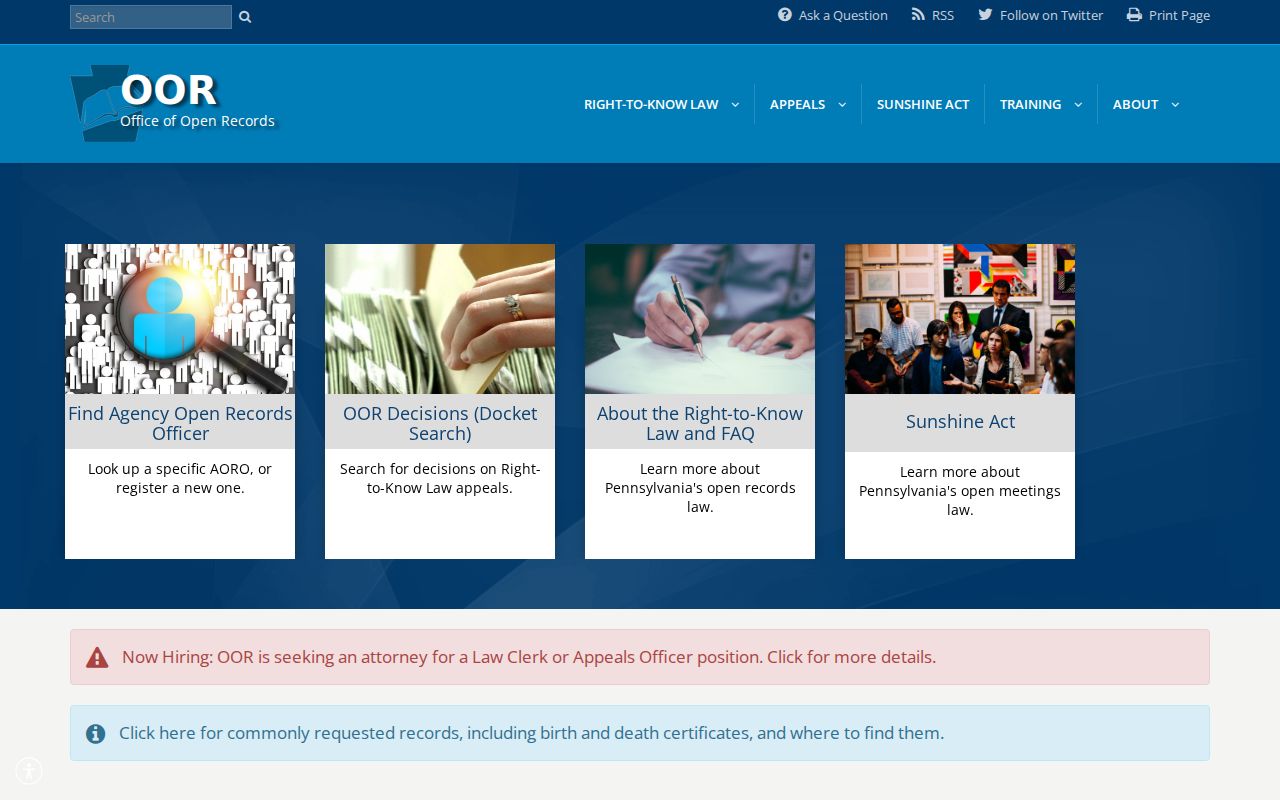
OOR is not a central courthouse repository and does not issue criminal histories, decrees, licenses, or pleadings.
Restricted Pennsylvania Court Records
Remote public access excludes or limits juvenile and dependency files, adoption records, mental-health material, sealed documents, confidential information forms, protected addresses, and personal identifiers. Family records can expose captions and order dates while financial statements, custody evaluations, or children's information remain protected. A public search omission is not proof that a case never existed.
Expungement removes qualifying information as the order and statute direct. Clean Slate limited access is different. It blocks ordinary public and most noncriminal-justice dissemination while preserving access for authorized justice and statutory users. Sealing follows the terms of the court order. Access to any restricted file may require proof of party status, counsel authority, fiduciary appointment, subpoena, statutory right, or a court order.
The Pennsylvania Courts news source gives current statewide judiciary context.
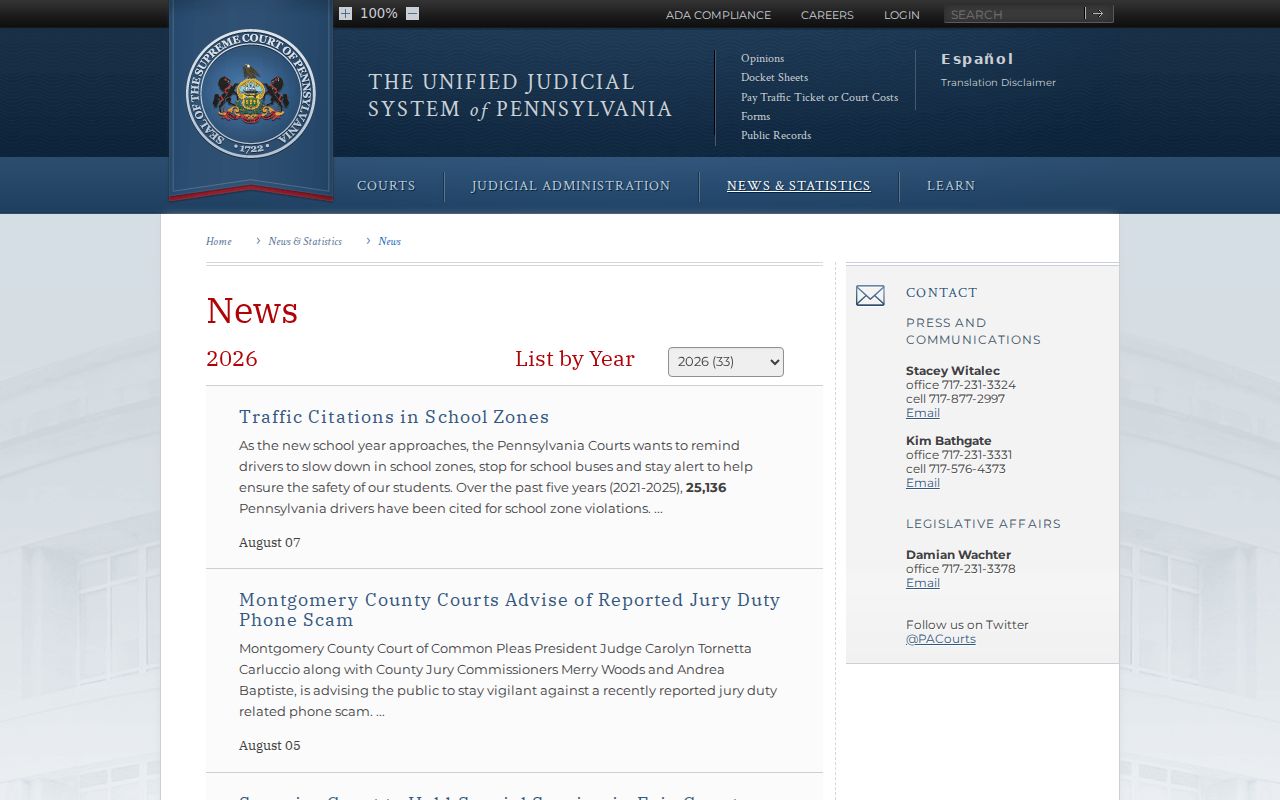
Operational announcements do not change a confidential file into a public one.
Find Pennsylvania Court Records by County
County selection follows the filing location, not always a person's current home. Criminal and civil documents route to the filing county. Marriage copies route to the issuing county. Probate starts with the decedent's domicile county. Traffic records route to the issuing court. These six populous counties represent major metro and suburban record systems, but every Pennsylvania county has a dedicated route.
Philadelphia County
Philadelphia · First Judicial District with specialized Municipal Court and record offices
Allegheny County
Pittsburgh · Consolidated civil, criminal, and Wills/Orphans' Court divisions
Montgomery County
Norristown · Large suburban Common Pleas district with split record offices
Bucks County
Doylestown · High-volume suburban district with county certification routes
Delaware County
Media · Populous southeastern county with distinct record custodians
Lancaster County
Lancaster · Major south-central district with many MDJs feeding Common Pleas
Browse the full directory of all 67 Pennsylvania counties to open the court records site for any county.
Pennsylvania Court Records Fees
UJS docket search and printing are free. The filed document may cost money at the custodian. Pennsylvania has no single retail price for plain, certified, or exemplified copies across all 67 county row offices. County schedules can include page, seal, search, retrieval, postage, automation, or other authorized components. Request a page count and estimate before ordering a large file.
| Product or Action | Statewide Figure or Rule |
|---|---|
| UJS docket search and print | Free |
| PATCH standard criminal check | $22; optional notarization adds $5 |
| PATCH qualifying volunteer check | $0 |
| PSP Access and Review | $20 by mail |
| PennDOT basic through full driver history | $15 |
| PennDOT certified driver record | $46 |
| Court copies and certification | Current court or county schedule |
Filing-cost waiver relief is judicial and does not automatically waive service, publication, transcript, vendor, certification, or opposing-party costs. RTKL agency-copy fees follow a different schedule from judicial case records. A plain copy reproduces a page. A certified copy adds the custodian's seal or certification, while exemplification adds further authentication when another jurisdiction requires it.
Interpret Pennsylvania Court Records
Read each count and event in date order. "Withdrawn" means the prosecution withdrew that charge at the relevant stage. "Dismissed" means the court ended it at that stage. "Not guilty" is an acquittal. "Guilty" or an accepted nolo contendere plea supports a conviction when followed by the applicable judgment and sentence. ARD is pretrial diversion, not a conviction, yet it can remain visible until qualifying dismissal and expungement processing.
"Held for court" or "waived for court" means charges moved past the preliminary stage, not that guilt was decided. A merged count may carry no separate sentence while still remaining legally relevant. Concurrent confinement terms run together as ordered; consecutive terms stack. Financial assessments do not equal the current balance, bail is not a fine, and a payment does not prove every condition has been satisfied.
Verify Pennsylvania Court Records
UJS is query-driven and can have session, CAPTCHA, maintenance, or outage limits. Coverage depth varies by system conversion and record series. Older civil, divorce, and estate files may require index books, microfilm, archive boxes, or a county historical collection. A portal result is an electronic representation, and the official file remains with the court. Download a fresh docket and obtain the latest order when a deadline, warrant, sentence, or judgment matters.
The Pennsylvania Courts research and statistics source documents statewide data work.
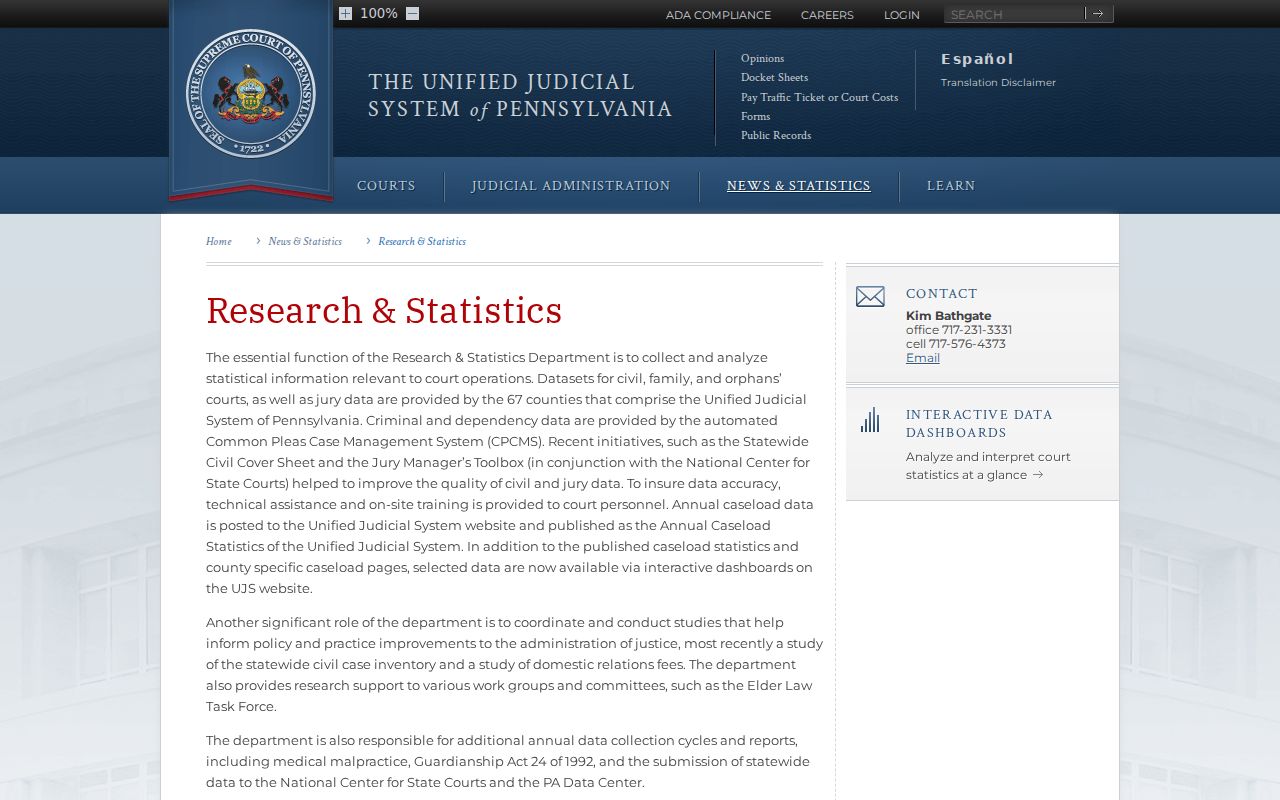
Aggregate statistics describe the system, not a substitute certified record for one person or case.
Note: Confirm urgent dates and legal status with the court that holds the official Pennsylvania case file before relying on a web docket.
Pennsylvania Court Records and Reform
Pennsylvania's Supreme Court traces to the Provincial Court established in 1684 and is described by the judiciary as the nation's oldest appellate court. Superior Court was created in 1895. Commonwealth Court began operating in 1970. The 1968 Constitution created the modern Unified Judicial System under Supreme Court administrative authority. Statewide automation later connected PACMS, CPCMS, and MDJS. Public appellate docket access began in 2001 and expanded across criminal Common Pleas and minor-court records.
AOPC reports that the connected systems docket more than 2.5 million cases each year and that the free portal exposes tens of millions of cases. The electronic reach is broad, but it does not turn AOPC into the custodian of every county paper, image, or certified decree.
The official 2024 Pennsylvania Courts news index records operational changes and the implementation period for expanded Clean Slate access.
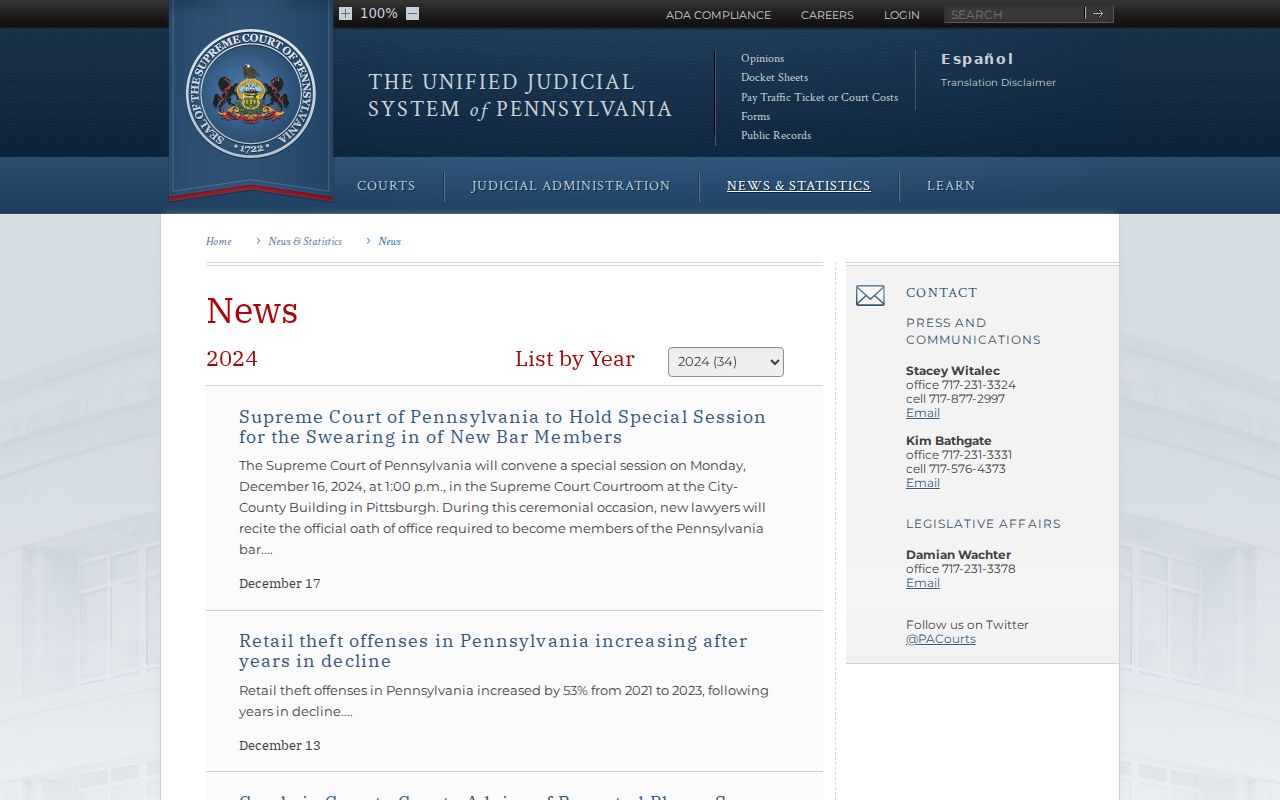
Clean Slate limited access changed dissemination rules, but it did not make qualifying records identical to expunged records.
The 2025 Pennsylvania Courts news index includes a critical system upgrade, behavioral-health summits, PFA data, and disaster-recovery work.
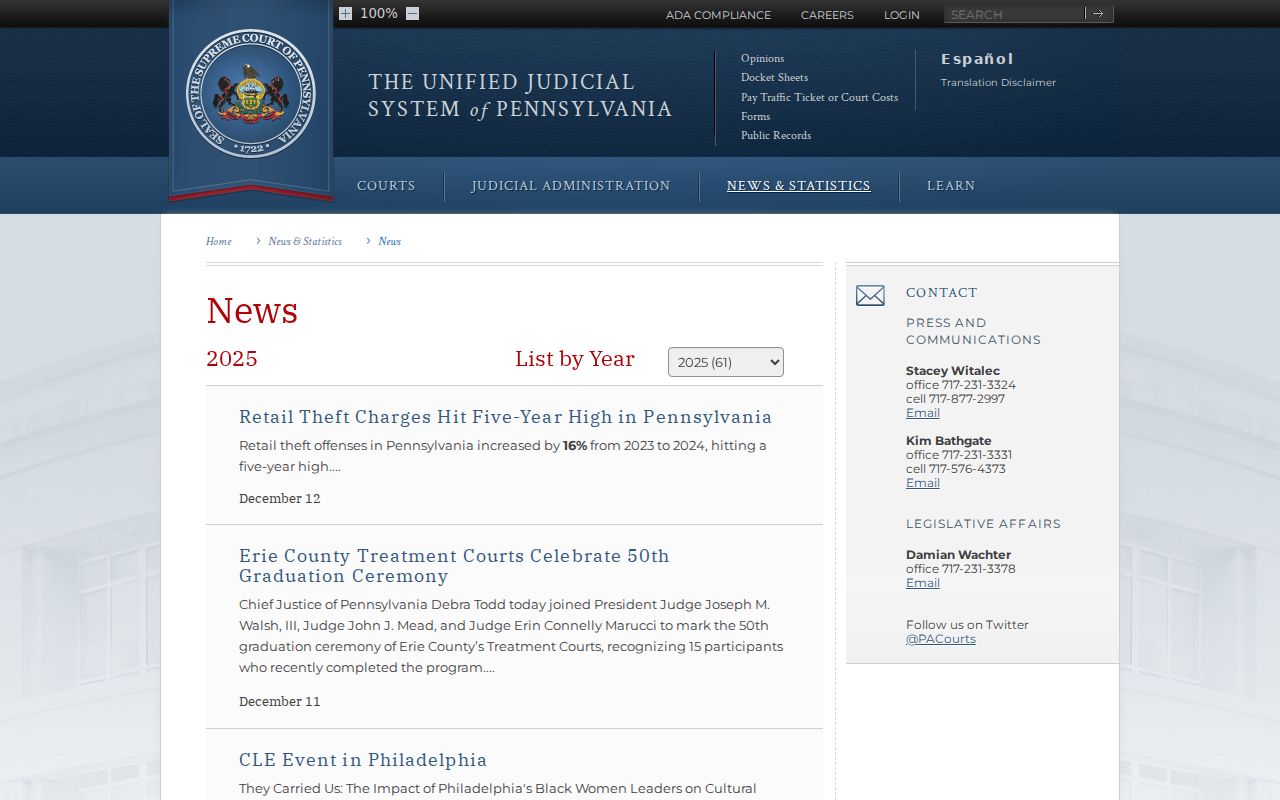
Maintenance and resilience work can affect portal availability, but a system outage does not automatically extend a court deadline.
Pennsylvania Court Records Questions
Is Pennsylvania Case Search free?
Yes. Public UJS Case Search features require no account, and docket sheets can be searched and printed without a portal fee. Filed documents, certification, archive retrieval, and county images may cost money.
Does UJS show every court document?
No. UJS is a statewide discovery layer. It does not promise every complaint, exhibit, transcript, civil image, probate paper, or confidential filing. Use the docket to identify the office, then request the document from its custodian.
Which Pennsylvania clerk has my record?
Common Pleas civil and divorce files usually route to the Prothonotary. Criminal files route to the Clerk of Courts. Estates and marriage licenses route to the Register of Wills, while an MDJ or Municipal Court keeps its own case file.
Are criminal charges the same as convictions?
No. A charge is an accusation. Read the disposition of every count for withdrawal, dismissal, acquittal, plea, or conviction. PATCH is also a separate compiled state criminal-history product, not the complete county court file.
Can I find sealed Pennsylvania records online?
Ordinary public search does not reveal sealed, expunged, limited-access, adoption, and many juvenile or mental-health records. Authorized access depends on the statute, order, and requester's legal role.
Where do certified Pennsylvania copies come from?
The office holding the official record certifies it. Appellate records use the appellate prothonotary. County civil, criminal, marriage, probate, and minor-court records use the matching county or court custodian.
What if a Pennsylvania docket is missing?
Try the exact docket and name variants, verify court level and county, then call the filing office. Ask about paper indexes, microfilm, archive transfer, sealed status, or data-entry delay without assuming that no case exists.